Security and compliance
Ensure data security and compliance with monitoring and change traceability
Ensure data security and compliance with monitoring and change traceability
Monitor and understand your databases with full visibility into performance and change
Build, test, and deploy database changes with confidence
Simplify and speed up database development workflows
Prepare reliable data foundations for AI initiatives
Simplify and secure database modernization across platforms
Control costs and boost efficiency in database operations
Simplify and speed up cloud database transformation
The Business Case for Redgate Flyway Enterprise
AI is accelerating software delivery across every team. The organizations pulling ahead are the ones governing every layer of the pipeline - including the database. Here's the evidence for why that matters, and what it's worth.

When database changes are governed, whether they're created by humans, AI or agents, teams move faster, costs fall, and value is delivered sooner. Here's the evidence.
"AI is a great amplifier, both of capability and of risk. The teams that will pull ahead are those that govern every part of their pipeline at the same level of maturity, with the same guardrails as human-generated code. The database is often a pipeline's weakest link. It doesn't have to be."
"As agentic systems scale, governance becomes the primary mechanism for control."
Why now
AI is making teams faster and more productive. But it also puts pipelines under pressure. Google DORA 2025 puts it directly: higher AI adoption correlates with increased delivery instability.[2] The pipeline is only as fast as its slowest step.
The answer isn't to slow down. It's to govern and stabilize. Yet for many organizations, the database is the ungoverned layer - the blind spot where AI-accelerated change meets manual process and exposes the most risk. Flyway Enterprise turns the database from a bottleneck into a competitive advantage.
81%
of enterprise technology leaders report a rise in production issues linked to AI-generated code
CloudBees 2026 · 200+ enterprise technology leaders[3]
40%
of enterprises will demote or decommission AI agents by 2027, due to governance gaps discovered only after production incidents
Gartner, May 2026[4]
33%
"only about one-third of organizations report maturity levels of three or higher in strategy, governance, and agentic AI governance"
McKinsey AI Trust Maturity Survey 2026 · ~500 organizations[5]
Reducing risks and cost with increased control
AI is generating high volumes of non-deterministic code, faster, across more teams. Production incidents are rising as a result - and the database is where failures are most costly and hardest to reverse. Governing the database layer with the same maturity applied to application code is the proven way to reduce risk and costs.

81%
of enterprise technology leaders report a rise in production issues linked to AI-generated code
CloudBees 2026 · 200+ enterprise technology leaders[1]
30%
of developers report little or no trust in AI-generated code
Google DORA 2025 · State of AI-assisted Software Development[2]
By bringing version-controlled, automated, and reliable, deterministic changes to the database layer, Flyway Enterprise directly targets the root causes of database deployment failure: manual steps, environment inconsistency, and lack of pre-deployment validation.
“90% of our operational support requests are gone. And it’s given us that crucial foundation we needed to scale to increasing business demand.”
Faster lead time, faster time to value
AI raises the ceiling on how fast teams can deliver. But a pipeline is only as fast as its slowest step - and for 39% of organizations, that step is still a manual database deployment.[14] Governed database change with Flyway Enterprise turns what was the constraint into an advantage: an automated, version-controlled layer that keeps pace with AI-generated change without adding risk.
Across Redgate Flyway customer case studies: deployments that took days or weeks now complete in minutes or hours. The common pattern is replacing manual, gated processes with an automated, version-controlled pipeline for database changes. Customers report an average 58% reduction in change lead time, rising to 98% reduction, depending on their baseline.
| Customer | Before | After | Reduction |
|---|---|---|---|
| Fortune 250 Financial | 12–24 hours | 20 minutes | 98% |
| US Credit Union | ~1 week | 4 hour window | 98% |
| Masterminds Group | 90 minutes | 6 minutes | 93% |
| Global Pharmaceutical | 5 days | 1 day | 80% |
* Average based on Flyway customer case studies. Figures self-reported by customers. Fortune 250 figure uses midpoint of reported 12–24hr range.
Why this matters more in an AI era
AI-driven development generates changes continuously. Manual, scheduled database deployments create a hard ceiling on how fast that value can ship. Automated database deployments with Redgate Flyway remove that ceiling.
AI accelerates the volume of changes hitting your pipeline. Smaller, more frequent deployments reduce the blast radius of any single change - and make it far easier to isolate and roll back a problem when it occurs.
AI-generated database changes need the same version control, testing, and review as human-written ones - or more. A governed pipeline ensures every change, regardless of origin, is validated before it reaches production.

After adopting Redgate Flyway, Verizon Connect shipped over 1,000 additional database changes per year - translating directly into the ability to better meet customer demand, faster.
Auditability and compliance confidence
When something fails in production, the question is always the same: what changed, when, and who approved it? At AI scale, that question becomes impossible to answer without a governed change management approach. Flyway Enterprise ensures every database change - from developers, AI tools, or agents - is version-controlled, policy-checked, tested, and auditable.
61%
of organizations have already undergone a compliance audit
Rising to 81% in financial services - and compliance issues are more often discovered during audits than through routine checks
Redgate State of the Database Landscape 2026[10]
49%
of organizations without a compliance audit rely on manual deployment
vs ~33% for those that have been audited - showing that organizations tend to govern database changes after audit pressure, not before
Redgate State of the Database Landscape 2026[10]
97%
of organizations now conduct two or more audits per year
While 1 in 4 organizations say managing multiple audits is their greatest compliance challenge.
A-LIGN 2026 Compliance Benchmark Report[11]
“A nice by-product of this is that it's so auditable. It's really nice to say, here's the model we deployed in production, and here are all the downstream changes.”
Automation frees teams
AI tools are giving engineering teams more capacity than ever - but only if the rest of the pipeline keeps pace. Every hour spent manually running scripts, reviewing deployments or chasing errors is an hour that could better be spent on value-add work. Automating database deployments with Redgate Flyway removes that constraint.
AI coding tools are generating significantly higher volumes of pull requests. Without code analysis, every database change requires costly manual inspection - consuming senior engineering time that should be spent on higher-value work.
Flyway Enterprise's built-in code analysis checks every database change before it even reaches a reviewer. Issues are flagged - crucially before they become incidents.
The results
Lower review costs, faster cycle times, and senior engineering time redirected to work that drives business value.
“We have saved around 2 hours a day across the data platform team, as we don't have to be interrupted with those manual tasks anymore.”
Protect revenue from downtime
Downtime is one of the most visible and costly consequences of ungoverned deployments. As AI accelerates the volume and pace of database changes, the exposure grows. With 39% of organizations still relying on manual database deployments, the pipeline is carrying more risk than leaders often realize.[14]

The figures represent total enterprise downtime exposure across all causes. Ungoverned database change is one significant and preventable contributor. As AI accelerates the pace of database change, that contribution grows.
$300k+
cost per hour of downtime for 90%+ of mid-to-large enterprises
ITIC 2024 Hourly Cost of Downtime Survey[13]
~$23m
Total estimated annual exposure - all causes
$300,000 × 77 hrs = $23,100,000 · Illustrative estimate based on data from independent sources
“The advantage is peace of mind. I know, guaranteed, that what I tested in the test environment is what is in production with Redgate Flyway.”
Speak with a Redgate specialist to understand how governing database change can help your organization remove risk, recover cost, and take the database off the critical path for AI delivery.
Downtime has many causes - infrastructure, application, and database failures among them. The figures represent total enterprise downtime exposure across all causes. Ungoverned database change is one significant and preventable contributor. As AI accelerates the pace of database change, that contribution grows.
$300k+ is the cost per hour of downtime for 90%+ of mid-to-large enterprises, according to the ITIC 2024 Hourly Cost of Downtime Survey.
77 hrs is the median annual downtime from high-impact outages, according to the New Relic 2024 Observability Forecast.
Combining those two figures results in an illustrative estimate of ~$23m as the total estimated annual exposure.
Flyway Enterprise reduces risk and costs of deployment failure
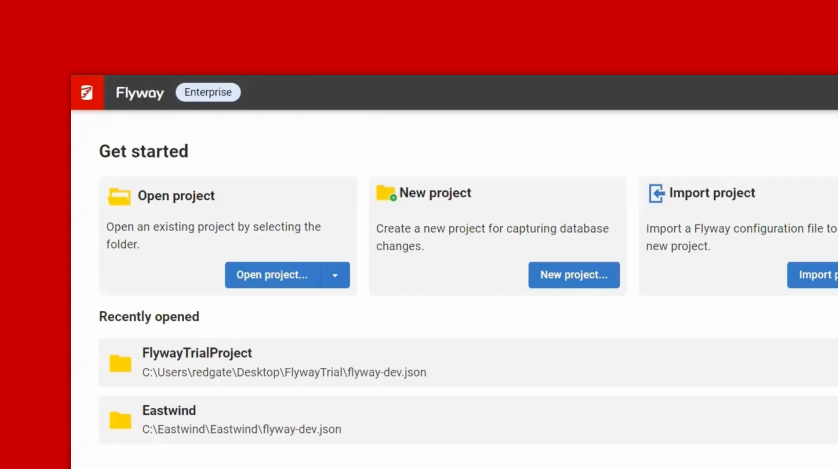
Flyway Enterprise gives teams the ability to govern database changes with the same maturity applied to application code. With advanced capabilities for script generation, code reviews, drift detection and change reporting, teams can reduce risk and costs of deployment failure.
AI is generating more work. Flyway Enterprise reduces the cost of managing it.
AI coding tools are generating significantly higher volumes of pull requests. Without code analysis, every database change requires costly manual inspection - consuming senior engineering time that should be spent on higher-value work.
Flyway Enterprise's built-in code analysis checks every database change before it even reaches a reviewer. Issues are flagged - crucially before they become incidents.
The results: lower review costs, faster cycle times, and senior engineering time redirected to work that drives business value.