


Why database governance in financial services is falling behind where it matters most
If anyone knows how to operate under scrutiny, it’s database teams within finance organizations. It’s a given considering the more rigorous compliance requirements and processes they must follow. But the 2026 State of the Database Landscape: Finance Edition reveals something more specific, and more uncomfortable, than the familiar story of regulatory pressure.
It’s the fact that, while the controls they’ve invested in over the years are (mostly) working, the risk has quietly migrated to the parts of the estate where those controls don’t yet reach.
Understanding where that database governance gap sits, and why it matters more now than it did two years ago, is essential to enabling real efficiencies with AI.
Where finance database controls are working in 2026
It's worth starting with the positives, because real progress has been made. Take manual testing and deployment, which has long been a source of inconsistency and audit friction. These issues are now only reported by 27% of finance industry respondents, compared to 39% across all industries.
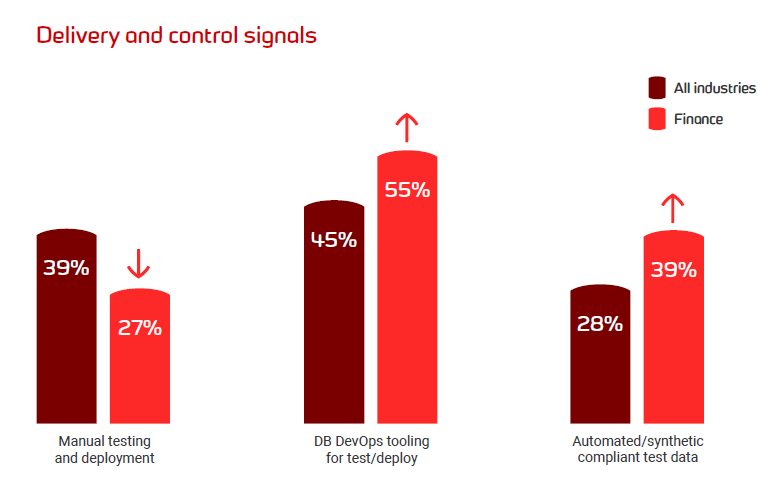
It’s a hugely positive step – especially considering dedicated Database DevOps tooling is in use at 55% of finance organizations, meaningfully ahead of the 45% seen elsewhere. This matters, because repeatability is what transforms compliance from a scramble into a by-product of normal delivery. When every change follows the same pipeline, evidence is captured by default - not reconstructed under pressure.
Monitoring tells a similar story. Vendor-provided database monitoring is used by 61% of finance industry respondents, with 42% also running third-party dedicated tools. The point isn't the tools themselves, but the consistency of visibility they enable.
In a regulated environment, the ability to detect fast, attribute clearly, and reconstruct what changed, is the difference between a manageable incident and a material one.
Why the database governance gap has shifted to analytics
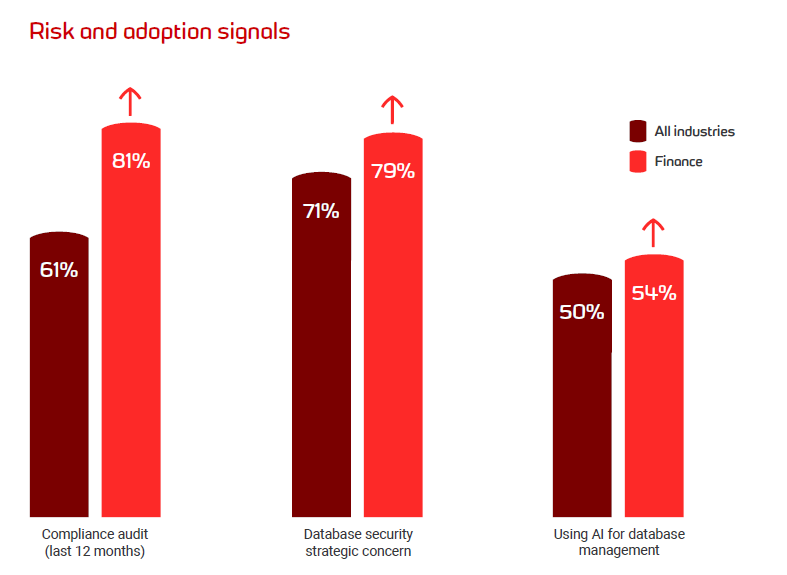
If the delivery pipeline is more repeatable and the monitoring is more consistent - and with 81% of finance organizations having undergone a compliance audit in the last 12 months - it makes sense that database security is seen as a strategic concern (79%).
The numbers don't suggest that the investments in tooling and delivery practices are failing, but it’s true that the risk has quietly and quickly escalated to areas outside of the individual controls.
The clearest signal is in analytics governance. Only 14% of finance industry respondents report using data governance or quality frameworks in their analytics environment. The cross-industry figure is 23%, which is itself not impressive, but finance falls further behind still. And this is exactly the territory that is expanding fastest: more platforms, more data transformation pipelines, more AI-generated outputs feeding into reporting and risk models.
"As we've moved away from monolithic systems, the number of databases and platforms has exploded. There's more sprawl than any one team can fully understand."
Brian Szadek, Assistant Vice President – Data, Cloud, & Event Platforms, United Wholesale Mortgage
Unfortunately, the consequences are practical. Finance industry respondents involved in data transformation and engineering have reported data quality issues at a rate of 58%, and 45% cite pipeline complexity or technical debt as a significant challenge.
These aren't abstract risks. They surface as inconsistent metrics, slower delivery and, in the most serious cases, an inability to trace a data point back to its origin when that question gets asked in an audit context.
"Governance is solid in transactional systems but drops off in analytics, exactly where AI and regulatory scrutiny are increasing. I've seen audit scenarios where tracing a single customer attribute across platforms required manual reconstruction due to missing end-to-end lineage. That's a real risk."
Mri Pandit, Senior Manager, Navy Federal Credit Union
How AI is widening the database governance gap in financial services
If the analytics governance gap were a slow-moving issue, there might be time to close it gradually. But AI is changing the pace of that trajectory.
47% of finance industry respondents are already using AI for database management, with a further 40% actively considering it. Among those already using AI, they’re using it for automating database management tasks (54%), and synthetic data generation (48%) - both sensible, low-risk starting points.
AI's appetite for data doesn't stay contained to just the safe corners of the estate, however. As organizations scale AI-driven analytics and reporting, the volume and speed of data transformation increases, and the governance mechanisms that make lineage defensible become more critical.
The risk then becomes the foundations it depends on, and whether these are strong enough to support the delivery. For example, clear ownership, auditable lineage, consistent access controls, etc, are underdeveloped in exactly the environments where AI is most active.
"Ultimately, we can't blame AI if there is a problem, because we're the ones who allowed it to happen. Just like you can't blame a junior for dropping the production database because you gave them access."
Scott Sauber, Director of Engineering, Lean TECHniques
Why test data management is a compliance risk in financial services
Test data is where these pressures converge, with teams requiring production-like validation to be confident their changes won't cause problems. But the more realistic the test data, the more risk introduced if sensitive data is handled inconsistently - and in finance, inconsistency in this area is a compliance event, not just an operational inconvenience.
39% of finance organizations now report using automated tools or synthetic data generation to ensure compliant test data. A meaningful improvement, yes, but it still means the majority continue to rely on manual approaches that introduce both risk and friction.
In the most recent DORA report, they place C-level executives personally responsible for having a data strategy and keeping data secure for the first time, raising the stakes for anyone who hasn't treated this as a first-class control.
"The challenge is that databases keep evolving. New columns appear, new data types get introduced, the business adds new use cases. And unless masking scripts evolve at the same pace, they drift out of date quickly and quietly."
Steve Jones, Advocate, Redgate Software
Managing database governance across hybrid environments
For the 42% of finance organizations running a mix of cloud and on-premises hosting, this hybrid approach creates additional challenges. It’s a similar story for the 36% who manage four or more distinct database platforms. And hybrid is no longer just a transition state; for most finance organizations, it’s now the permanent operating model.
That changes what good governance looks like, since a control that works in one environment, but not another, is a compliance gap waiting to be found. Additionally, consistency of standards, visibility, and evidence trails must work across the whole estate by design - not exception.
Database governance priorities for technical leaders in 2026
The data points to a clear set of priorities for technical leaders in the finance industry in 2026:
- Close the analytics governance gap. Formalize governance and quality frameworks in analytics environments so that lineage, ownership, and access boundaries are defensible - not reconstructed after the fact.
- Extend delivery discipline into analytics pipelines. The repeatability gains made in transactional change delivery need to follow data into analytics and transformation workflows.
- Make test data a first-class control. Expand synthetic data generation and masking so teams can validate realistically without increasing exposure. Manual workarounds that drift out of date quietly are not a sustainable approach.
- Define AI's boundaries before they're tested. Establish clear policies for how AI can interact with schema, code, and data, then enforce them through tooling and process rather than guidelines alone.
- Design controls for hybrid by default. Common standards, shared visibility, and consistent evidence trails need to work across cloud and on-premises environments, not just within them.
The finance sector has done the harder work of building repeatable delivery practices and maintaining operational visibility in its core systems. The next step isn't starting over. It's extending that discipline into the parts of the estate where regulatory scrutiny is heading next.
*This post draws on findings from the 2026 State of the Database Landscape: Finance Edition, based on a survey of 2,150 IT professionals globally.
This document contains proprietary information and is protected by copyright law.
Copyright © 2026 Red Gate Software Limited. All rights reserved
Read next

Blog post
Building the Foundations for AI Readiness
Everyone wants to move faster with AI, but few are truly ready for it. This is where organizations can position themselves better as AI readiness isn’t just about algorithms, it’s about whether your data, systems, and teams are prepared to support intelligent automation safely and effectively. According to Redgate’s 2025 ‘State of the Database Landscape’ study, 91% of organizations are still not considered AI-data-ready. Data sprawl, unclear ownership, and fragile pipelines mean teams spend more time fixing problems than driving progress. It’s important to remember that while technology is constantly evolving, organizations must evolve too otherwise the repercussions are waves

Blog post
Database Security Failures Don’t Start in Security Teams
When a database security incident happens, everyone turns to the security team. We look for a simple root cause analysis, and then we add a control, tighten a policy, and maybe even buy a silver bullet tool. We feel progress! But the incident didn’t start there. It started years earlier, when the organization made a series of perfectly reasonable decisions that quietly expanded the surface area and weakened the consistency of control. “Let’s add a new platform for this workload”, “Let’s move this bit to the cloud” or even “let’s introduce AI to speed up the boring bits”. None of
Report
State of the Database Landscape 2026: Finance Edition
This finance edition focuses on organizations working under heightened regulatory scrutiny, where control over data, access, and change must not only exist, but be provable through consistent practices and clear evidence trails.
You may also like

Blog
Oracle Schema Existence Checks are Now in Preview in Flyway Enterprise
Blog
Without Governance, AI Is Just Faster Failure

Blog
Loading comments...