


Your developers are using AI agents, your data exposure just multiplied
Your developers are already using AI agents. GitHub Copilot, Cursor, Claude Code. Not just for autocomplete, but to generate features, run test suites, and iterate across branches. Each agent needs a database to work against. And in most organizations, nobody has checked what's actually in that database, or whether it should be there
The deeper problem is that test data governance was already fragile before agents arrived. Most teams are running a masking script someone wrote a couple of years ago. It covers the columns whoever built it thought to include, and misses the ones added since. When it fails there are no logs, no outputs, just a restored database and another attempt. Nobody's fully confident it's catching everything.
That's a serious risk on its own. Real customer data, patient records, payment card numbers, account details, sitting in test environments that aren't secured to production standards. The environments your developers work in every day.
AI agents don’t create that problem, but they make it harder to contain. When a developer had to request data from a DBA, there was a human checkpoint. Someone provisioned the environment, ran the masking step, and handed over something that was at least intended to be clean. An AI agent skips that entirely. It doesn't submit a request. It doesn't wait for a masked copy. Instead, it connects to whatever database is available and starts working, by passing any existing controls and processes.
When customer data is exposed, nobody asks which environment it came from. The clients whose data ends up in an unsecured dev environment won't make a distinction between that and a production breach. Contracts get pulled. Certifications lapse. The reputational damage with clients who trust you with their sensitive data is often harder to recover from than the breach itself.
HIPAA's proposed Security Rule overhaul, expected to finalize mid-2026, requires production-level controls everywhere patient data exists, including test databases where data isn't masked. PCI-DSS v4.0 explicitly prohibits live card numbers in pre-production. GDPR applies to any organization handling EU resident data. "It was only a test environment" isn't a defense any of them accept.
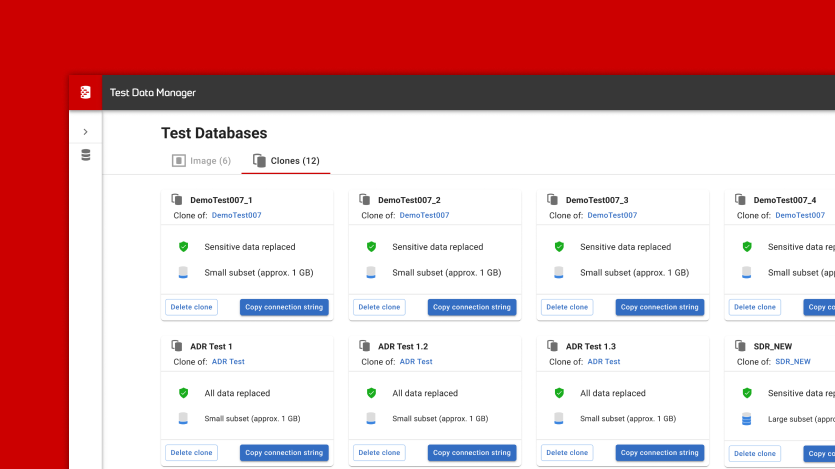
Automated PII discovery and masking built into your provisioning pipeline brings back control. Masking rules are configured once in a tool like Redgate Test Data Manager, then triggered automatically every time an environment is provisioned, whether by a developer, a DBA, or an agent. Every environment gets PII-free data by default. The rules maintain referential integrity when your schema changes, and every run is logged, so you have an audit trail that doesn't depend on anyone remembering to produce it.
Ben Wiggin, Senior DBA at a US financial organization put it this way after replacing a manual process that had run for over 20 hours at a time:
"We had Redgate Test Data Manager configured in less than a day…it didn't just make the process faster, it made it understandable and maintainable. Giving us visibility and control we simply didn't have before."
This isn’t just about faster masking; it’s about knowing what data your environments contain and being able to prove it.
Try Test Data Manager free for 28 days, and get automated, secure test data provisioned in under 30 minutes.
Frequently asked questions
Is production data in test environments really a risk if nothing has gone wrong yet?
Yes. The absence of a known breach isn't evidence the data is safe. Masking scripts that haven't been audited recently, or that were written against an older version of your schema, may not be covering every sensitive column. PII in a test environment carries the same regulatory exposure as PII in production under HIPAA, PCI-DSS, CCPA, and GDPR. Most organizations only find the gap during an audit or after an incident.
What's so bad about masking scripts and what's the alternative?
Masking scripts are written against a specific schema at a point in time. When tables are added, columns are renamed, or data types change, the script either breaks or silently stops covering the new fields. Purpose-built tools like Redgate Test Data Manager classify your schema continuously, apply masking rules that maintain referential integrity across changes, and log every run, so you're not relying on something that may not have kept pace with your database.
How long does it take to implemented a test data management solution?
Ben Wiggin, Senior DBA at a US financial organization replaced his existing tool with Redgate Test Data Manager in less than a day. Most teams are provisioning compliant data within their first day, without consultants or a multi-month implementation.
Check out the case study here.
Does Redgate Test Data Manager's AI classification send data outside our environment?
No. Classification runs locally, within your own infrastructure. No data leaves your network. In financial services and healthcare accounts, data residency is typically a procurement requirement under HIPAA and PCI-DSS, so this is worth confirming with any tool you evaluate.
This document contains proprietary information and is protected by copyright law.
Copyright © 2026 Red Gate Software Limited. All rights reserved
Tools in this post
 Redgate Test Data Manager
You may also like

Blog
Announcing Redgate Flyway Enterprise’s advanced capabilities for Databricks now in Preview

Blog
Test Data Manager: One-click deployment on AWS cloud

Blog
Loading comments...