Redgate Monitor 10.0.5 now supports a user role called "Reports user". A user added to this role, by an administrator, will be able to 'self-serve' Redgate Monitor reports but won't be able to configure any other aspect of the monitoring service. Jeremiah Peschka explains how it works.Read more
Not only are Redgate Monitor Groups probably the neatest and most maintainable way of ensuring that all your SQL Servers have the best possible configuration of alerts, but they represent a powerful way of categorizing your SQL Server estate. In this article, I'll show how to use the Redgate Monitor…Read more
How to use RAISERROR() in T-SQL to send annotations to Redgate Monitor, so you can observe the direct impact of application tasks, or server changes, on the SQL Server metrics.Read more
You need to make sure that nobody tampers with your production databases, or really any databases outside Development. Even if you weren't of a nervous disposition, you'd want to know if a database was stopped or removed. You'd also be intrigued by the sudden unrehearsed addition of a database to…Read more
Splunk is a search engine for collecting and analyzing all sorts of "machine data", including log data and metrics for SQL Server. Redgate Monitor gives you the detailed diagnostic view of all your SQL Server instances, and databases. If you have Splunk to monitor your applications and server infrastructure, and…Read more
New Relic Infrastructure is a capable server monitoring tool but adding Integrations provides only 'bare bones' monitoring for SQL Server. Grant Fritchey argues that to "instrument" a complex system such as SQL Server, effectively, you also need a tool that is built specifically for this purpose.Read more
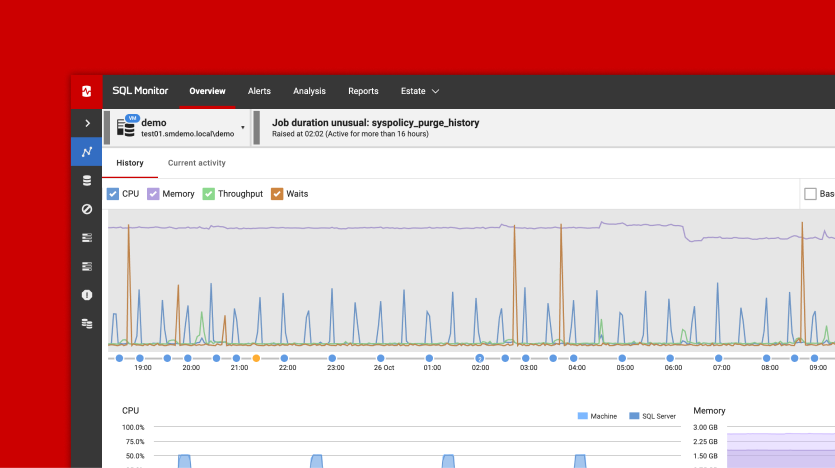
When the tempdb database is heavily used, processes in any database on the instance will be forced to wait, due to contention as the SQL Server engine tries to manage allocation pages in tempdb. Phil Factor shows how to monitor for signs of trouble.Read more
With simple integration, SCOM and Redgate Monitor combine breadth and depth, infrastructure-wide observability plus SQL Server insight. The result is faster incident response, smarter use of DBA time, and monitoring that scales with growth and new technologies.Read more
This article explains the Azure-tailored metrics and alerts in Redgate Monitor that track use of the limited compute resources available to an Azure SQL Elastic Pool, and to each of the databases in it.Read more