Security and compliance
Ensure data security and compliance with monitoring and change traceability
Ensure data security and compliance with monitoring and change traceability
Monitor and understand your databases with full visibility into performance and change
Build, test, and deploy database changes with confidence
Simplify and speed up database development workflows
Prepare reliable data foundations for AI initiatives
Simplify and secure database modernization across platforms
Control costs and boost efficiency in database operations
Simplify and speed up cloud database transformation

AgFirst Farm Credit Bank, a US based financial services organization, supports a nationwide agricultural lending network operating in highly regulated environments.
A fragmented database monitoring approach limited their estate visibility, increased audit effort, and made it harder for teams to move from reactive to proactive operations.
AgFirst implemented Redgate Monitor to centralize database monitoring, improve insight into performance and availability, and support audit and modernization goals.
The database team reduced investigative effort, improved confidence during audits, and gained clearer visibility across production and non-production environments.
AgFirst Farm Credit Bank provide wholesale funding, as well as technology and other value-added services, to Association partners (local lending institutions) in more than 15 states. Those Associations provide loans and related financial services to rural residents and agricultural operations of all sizes. A $50+ billion company, they are proud to be one of four wholesale banks within the nationwide Farm Credit System.
The organization operates in a tightly regulated environment, with internal policies and external oversight that place a premium on stability, traceability, and operational control.
From a database perspective, AgFirst runs a predominantly Microsoft SQL Server estate. The environment is 98% Microsoft SQL, with a small number of Oracle databases that the team plan to bring into a more unified monitoring approach over time. The database team includes around 15 DBAs, supported by an offshore team in India to provide 24/7 coverage.
Over time, the bank also started expanding monitoring access to other teams with a longer-term goal of using captured metrics to produce dashboards for executives as the organization matured its operational reporting.
 $50+ BillionCompany90,000+Customers
“It’s a great experience all around working with your staff. The technical staff are some of the best in the world, and it’s clear that you really want to support us.”
Jason Malpass, Senior Database Administrator

In production, AgFirst monitor roughly 130 databases, with the non-production footprint expanding significantly to support testing and parallel delivery. The organization grouped environments at a high level into production, non-production, and training, but in practice non-production included multiple tiers to support ongoing initiatives.
One of these key initiatives is their data modernization strategy, including major platform changes and a planned AWS cloud migration beginning this year.
As AgFirst’s application landscape evolves, the operational pressure on the database estate increases. Non-production environments have ballooned to support concurrent projects and integrated testing, and the team need confidence that issues can be identified and resolved quickly. Ideally before they became business-impacting incidents.
Historically, the team relied on more than one monitoring tool from different vendors. While those tools provided alerts, the overall experience was increasingly shaped by three problems:
Cost was the trigger to look more broadly, but usability and fit became the deciding factors. “We were under a lot of cost and expense pressure, so the impetus was us sticking our head up and saying, is there something better out there?” said Michael Webster, Director of Database Development Services at AgFirst.
As the bank move deeper into modernization work with more integrated testing, more moving parts, and more scrutiny, the core requirement became not simply ‘more monitoring’. They need a clearer, faster way to understand what is happening inside their estate, and to share that evidence across teams when issues crossed boundaries.
“Redgate’s roadmap was a part I was keeping my eye on a lot. It offered us us flexibility for a potential future state where we're moving towards Postgres.”
Michael Webster, Director of Database Development Services
AgFirst chose Redgate Monitor to centralize their estate monitoring and align it with both day-to-day operational needs, and longer-term platform strategy.
The organization already had more than 20 years of experience with Redgate tools, including SQL Backup, SQL Prompt, SQL Compare, and SQL Data Compare. That existing relationship, and prior experiences working closely with Redgate support, helped reduce implementation risk and gave the team confidence the product would be supported in the way they needed.
AgFirst’s Senior Database Administrator, Jason Malpass, pointed to the quality of that support relationship as a differentiator. “It’s a great experience all around working with your staff. Your technical staff are some of the best in the world, very knowledgeable and very into the technical nuts and bolts. It’s clear that you guys really want to support us, and what we’re trying to accomplish here, and give us the tools to do this.”
In addition to the immediate operational benefits, AgFirst recognized the importance of Redgate’s ongoing innovation and alignment with their long-term strategy. The flexibility offered by Redgate Monitor was particularly appealing, as AgFirst anticipates a future where its estate might include open database platforms such as PostgreSQL, among others. This adaptability ensures that its monitoring solution can evolve alongside the organization’s technology choices. Michael summarized this saying “Redgate’s roadmap was a part I was keeping my eye on a lot. What are the things that Redgate’s investing in, and how does that align to meet our strategy? It offered us flexibility for a potential future state where we’re moving towards Postgres”.
Equally significant has been AgFirst’s relationship with Chris, their Account Executive. Michael described the dynamic as a genuine partnership, highlighting the value of open dialogue and collaborative planning. “Having those conversations with Chris as a partner through this whole thing has been really beneficial for all of us,” he said, underscoring the trust and support that underpin their ongoing engagement with Redgate.
From a technical and operational standpoint, Redgate Monitor also aligned with AgFirst’s preferences around deployment and maintainability. Particularly its lightweight, agentless architecture and web-based experience. “The architecture really appealed to me. It was agentless, it was all web based, it was lightweight,” outlined Michael.
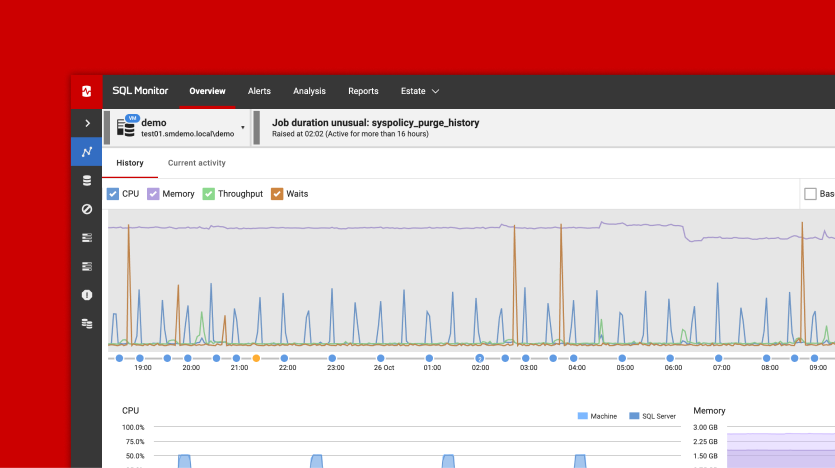
During the proof of concept, responsiveness stood out as well. The team found it quicker to move through the UI and reach the information needed to begin diagnosis. This matters in their 24/7 operational model where minutes lost to tooling friction compound quickly.
Implementation was straightforward. Michael initially expected to rely on guided installation but instead found he could complete the setup easily. “I was actually playing around with it, and it was so easy I got the initial install up and running right by myself,” he said.
They were therefore able to use their time with the Redgate Professional Services team to focus on what would drive value fastest: configuring alerts and shaping the monitoring experience to match AgFirst’s priorities.
“The architecture really appealed to me. It was agentless, it was all web based, it was lightweight.”
Michael Webster, Director of Database Development Services

Although AgFirst are still early on in their journey with Redgate Monitor, the benefits are already clear in the day-to-day work of the DBA team.
The team uses Redgate Monitor heavily for deadlocks and long-running queries, using captured history to understand what changed, what spiked, and where contention was building. “We get a lot of alerts for deadlocks and long-running queries, we were able to go back and see what drove this to lock up, or to hang, or wait,” Michael said.
The team also found it easier to locate the detail needed to move from alert to root cause. “For me, it’s been a lot easier to find things than it was in the other tool,” Jason added. In practice, improved monitoring wasn’t just about DBA efficiency, it also made it easier to provide developers with specific, actionable evidence. In one example, the team traced an issue back to a trigger and shared that detail directly with the development team, helping them correct the underlying process.
One of the most immediate benefits came from automated discovery and estate visibility. What had previously been a manual effort became a repeatable, automated process that supported audit requirements. As Michael explained, “From an inventory perspective, the auto search actually got me through an audit point we were doing manually before.”
AgFirst also benefitted from how Redgate Monitor is able to capture backups providing valuable detail on whether a backup has been complete, when it was completed and the overall RPO. “We weren’t even asking for that, but it was one of the benefits of pairing your various tools together,” Michael said.
Together, these changes reduced investigative effort, improved cross-team collaboration, and strengthened confidence that the database estate could be monitored and managed consistently as modernization work continued.
Looking ahead
AgFirst’s longer-term goal is to use Redgate Monitor not just to respond to incidents, but to shift the team toward proactive operations, surfacing potential risk earlier and preventing issues before they became disruptive.
The team see this as a gradual journey. Building on historical reactionary cost and incident patterns to demonstrate the value of earlier awareness, and evolving alerting toward more predictive, pre-emptive signals.
AgFirst Farm Credit Bank, a US based financial services organization, supports a nationwide agricultural lending network operating in highly regulated environments.
A fragmented database monitoring approach limited their estate visibility, increased audit effort, and made it harder for teams to move from reactive to proactive operations.
AgFirst implemented Redgate Monitor to centralize database monitoring, improve insight into performance and availability, and support audit and modernization goals.
The database team reduced investigative effort, improved confidence during audits, and gained clearer visibility across production and non-production environments.
“It’s a great experience all around working with your staff. The technical staff are some of the best in the world, and it’s clear that you really want to support us.”
Jason Malpass, Senior Database Administrator
AgFirst Farm Credit Bank provide wholesale funding, as well as technology and other value-added services, to Association partners (local lending institutions) in more than 15 states. Those Associations provide loans and related financial services to rural residents and agricultural operations of all sizes. A $50+ billion company, they are proud to be one of four wholesale banks within the nationwide Farm Credit System.
The organization operates in a tightly regulated environment, with internal policies and external oversight that place a premium on stability, traceability, and operational control.
From a database perspective, AgFirst runs a predominantly Microsoft SQL Server estate. The environment is 98% Microsoft SQL, with a small number of Oracle databases that the team plan to bring into a more unified monitoring approach over time. The database team includes around 15 DBAs, supported by an offshore team in India to provide 24/7 coverage.
Over time, the bank also started expanding monitoring access to other teams with a longer-term goal of using captured metrics to produce dashboards for executives as the organization matured its operational reporting.
“Redgate’s roadmap was a part I was keeping my eye on a lot. It offered us us flexibility for a potential future state where we're moving towards Postgres.”
Michael Webster, Director of Database Development Services
In production, AgFirst monitor roughly 130 databases, with the non-production footprint expanding significantly to support testing and parallel delivery. The organization grouped environments at a high level into production, non-production, and training, but in practice non-production included multiple tiers to support ongoing initiatives.
One of these key initiatives is their data modernization strategy, including major platform changes and a planned AWS cloud migration beginning this year.
As AgFirst’s application landscape evolves, the operational pressure on the database estate increases. Non-production environments have ballooned to support concurrent projects and integrated testing, and the team need confidence that issues can be identified and resolved quickly. Ideally before they became business-impacting incidents.
Historically, the team relied on more than one monitoring tool from different vendors. While those tools provided alerts, the overall experience was increasingly shaped by three problems:
Cost was the trigger to look more broadly, but usability and fit became the deciding factors. “We were under a lot of cost and expense pressure, so the impetus was us sticking our head up and saying, is there something better out there?” said Michael Webster, Director of Database Development Services at AgFirst.
As the bank move deeper into modernization work with more integrated testing, more moving parts, and more scrutiny, the core requirement became not simply ‘more monitoring’. They need a clearer, faster way to understand what is happening inside their estate, and to share that evidence across teams when issues crossed boundaries.
“The architecture really appealed to me. It was agentless, it was all web based, it was lightweight.”
Michael Webster, Director of Database Development Services
AgFirst chose Redgate Monitor to centralize their estate monitoring and align it with both day-to-day operational needs, and longer-term platform strategy.
The organization already had more than 20 years of experience with Redgate tools, including SQL Backup, SQL Prompt, SQL Compare, and SQL Data Compare. That existing relationship, and prior experiences working closely with Redgate support, helped reduce implementation risk and gave the team confidence the product would be supported in the way they needed.
AgFirst’s Senior Database Administrator, Jason Malpass, pointed to the quality of that support relationship as a differentiator. “It’s a great experience all around working with your staff. Your technical staff are some of the best in the world, very knowledgeable and very into the technical nuts and bolts. It’s clear that you guys really want to support us, and what we’re trying to accomplish here, and give us the tools to do this.”
In addition to the immediate operational benefits, AgFirst recognized the importance of Redgate’s ongoing innovation and alignment with their long-term strategy. The flexibility offered by Redgate Monitor was particularly appealing, as AgFirst anticipates a future where its estate might include open database platforms such as PostgreSQL, among others. This adaptability ensures that its monitoring solution can evolve alongside the organization’s technology choices. Michael summarized this saying “Redgate’s roadmap was a part I was keeping my eye on a lot. What are the things that Redgate’s investing in, and how does that align to meet our strategy? It offered us flexibility for a potential future state where we’re moving towards Postgres”.
Equally significant has been AgFirst’s relationship with Chris, their Account Executive. Michael described the dynamic as a genuine partnership, highlighting the value of open dialogue and collaborative planning. “Having those conversations with Chris as a partner through this whole thing has been really beneficial for all of us,” he said, underscoring the trust and support that underpin their ongoing engagement with Redgate.
From a technical and operational standpoint, Redgate Monitor also aligned with AgFirst’s preferences around deployment and maintainability. Particularly its lightweight, agentless architecture and web-based experience. “The architecture really appealed to me. It was agentless, it was all web based, it was lightweight,” outlined Michael.
During the proof of concept, responsiveness stood out as well. The team found it quicker to move through the UI and reach the information needed to begin diagnosis. This matters in their 24/7 operational model where minutes lost to tooling friction compound quickly.
Implementation was straightforward. Michael initially expected to rely on guided installation but instead found he could complete the setup easily. “I was actually playing around with it, and it was so easy I got the initial install up and running right by myself,” he said.
They were therefore able to use their time with the Redgate Professional Services team to focus on what would drive value fastest: configuring alerts and shaping the monitoring experience to match AgFirst’s priorities.
Although AgFirst are still early on in their journey with Redgate Monitor, the benefits are already clear in the day-to-day work of the DBA team.
The team uses Redgate Monitor heavily for deadlocks and long-running queries, using captured history to understand what changed, what spiked, and where contention was building. “We get a lot of alerts for deadlocks and long-running queries, we were able to go back and see what drove this to lock up, or to hang, or wait,” Michael said.
The team also found it easier to locate the detail needed to move from alert to root cause. “For me, it’s been a lot easier to find things than it was in the other tool,” Jason added. In practice, improved monitoring wasn’t just about DBA efficiency, it also made it easier to provide developers with specific, actionable evidence. In one example, the team traced an issue back to a trigger and shared that detail directly with the development team, helping them correct the underlying process.
One of the most immediate benefits came from automated discovery and estate visibility. What had previously been a manual effort became a repeatable, automated process that supported audit requirements. As Michael explained, “From an inventory perspective, the auto search actually got me through an audit point we were doing manually before.”
AgFirst also benefitted from how Redgate Monitor is able to capture backups providing valuable detail on whether a backup has been complete, when it was completed and the overall RPO. “We weren’t even asking for that, but it was one of the benefits of pairing your various tools together,” Michael said.
Together, these changes reduced investigative effort, improved cross-team collaboration, and strengthened confidence that the database estate could be monitored and managed consistently as modernization work continued.
Looking ahead
AgFirst’s longer-term goal is to use Redgate Monitor not just to respond to incidents, but to shift the team toward proactive operations, surfacing potential risk earlier and preventing issues before they became disruptive.
The team see this as a gradual journey. Building on historical reactionary cost and incident patterns to demonstrate the value of earlier awareness, and evolving alerting toward more predictive, pre-emptive signals.
This document contains proprietary information and is protected by copyright law.
Copyright © 2026 Red Gate Software Limited. All rights reserved
Whether you want more details about Redgate Monitor, a demo or information on best practices – get in touch with us.

Redgate has specialized in database software for over 25 years. Our products are used by 92% of the Fortune 100. 200,000 customers rely on Redgate worldwide.

Redgate offers comprehensive documentation and a friendly, helpful support team. An average 87% of customers rate our support 'Excellent'.