Security and compliance
Ensure data security and compliance with monitoring and change traceability
Ensure data security and compliance with monitoring and change traceability
Monitor and understand your databases with full visibility into performance and change
Build, test, and deploy database changes with confidence
Simplify and speed up database development workflows
Prepare reliable data foundations for AI initiatives
Simplify and secure database modernization across platforms
Control costs and boost efficiency in database operations
Simplify and speed up cloud database transformation
Choosing the right database monitoring platform delivers measurable returns across the business. Redgate Monitor helps protect revenue, reduce data compliance costs and uncover hidden spend across your database estate. Here are eight ways it drives value.
For over 90% of mid to large enterprises, a single hour of unplanned downtime costs more than $300,000, according to ITIC’s 2024 Hourly Cost of Downtime survey. Database issues can become customer facing incidents in minutes, making fast detection critical to protecting revenue and brand trust. In a Redgate survey of database professionals, teams using dedicated monitoring reduced time to detect issues by 28% and time to recover by 22%, limiting customer impact and disruption.
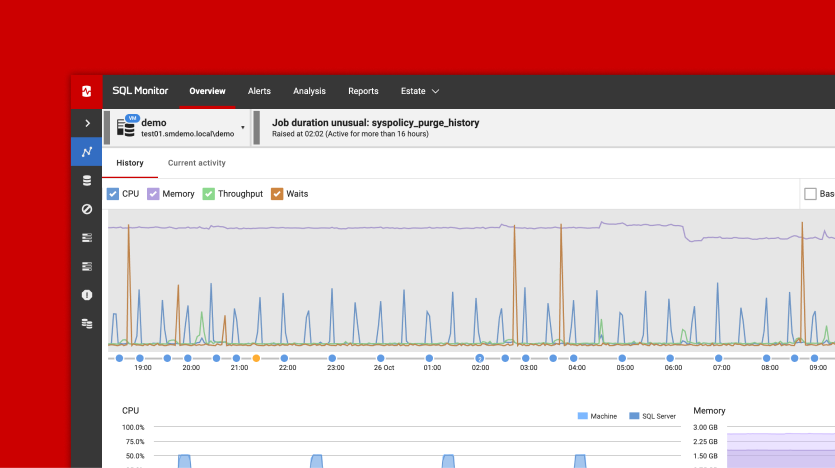
Redgate Monitor supports this with high quality alerting that surfaces genuine problems early. More than 65 preconfigured database-specific alerts and adaptive thresholds reduce noise, enabling teams to act before customers notice and issues escalate.
Strengthen operational resilience with Redgate Monitor Enterprise: High availability architecture with load balancers keeps monitoring running uninterrupted during system failures, so the tool your team depends on is available at the exact moment it matters most.
The State of the Database Landscape 2026 report found that 84% of organizations now run two or more database platforms, with 43% operating hybrid environments. That complexity increases migration risk and slows progress, as workload behavior and performance characteristics change across platforms and environments.
Redgate Monitor provides a single pane of glass across SQL Server, PostgreSQL, Oracle, MySQL and MongoDB, enabling teams to establish baselines before migration and maintain visibility throughout the transition. That continuity of insight reduces uncertainty, accelerates decision making and helps cloud migrations progress with greater predictability and control. It also helps teams right-size resources from the outset, using historical consumption data to avoid over-provisioning and keep spend aligned with actual demand.
During a performance incident, attention shifts away from planned work toward investigation and stabilization. Experienced specialists are drawn into diagnosis and explanation, reducing capacity elsewhere and increasing reliance on a small number of individuals. As time to root cause extends, disruption and opportunity cost build in parallel.
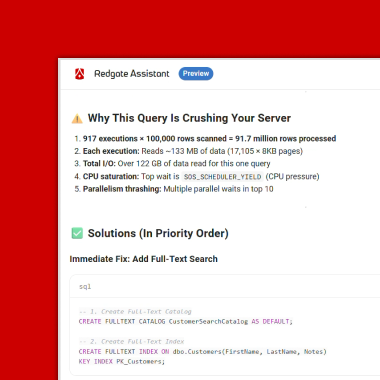
A monitoring tool shortens this cycle by making issues clearer earlier. With Redgate Monitor, AI Query Analysis identifies specific query performance problems and presents the underlying cause with recommendations on how to address the issue. AI Alert Analysis goes further by attaching cause and suggested remediation directly to alerts for blocking, deadlocks and long running queries at the moment they notify a user.

Regulatory compliance is one of the fastest-growing cost pressures in IT. A-LIGN’s 2026 Compliance Benchmark Report found that 97% of organizations now conduct two or more audits per year, with 1 in 4 stating the greatest challenge to their compliance strategy is conducting multiple audits. Each cycle demands evidence: configuration checks, permissions audits, proof of controls. For businesses still assembling that evidence manually, the cost in specialist time alone is significant and it recurs every cycle.
Automate compliance reporting with Redgate Monitor Enterprise: Access rights and permission changes are captured continuously as part of normal monitoring in Redgate Monitor Enterprise. The audit trail exists before anyone asks for it, timestamped and ready to export.
Organizations run infrastructure tooling in different ways. Some teams operate monitoring within their own environments and manage it directly. Others require a fully managed service that aligns with a SaaS first operating model. Redgate Monitor supports both approaches with a consistent pricing structure, allowing teams to choose what fits their organization without commercial compromise.
Redgate Monitor SaaS removes the overhead of running the monitoring platform itself. Redgate handles hosting and platform management, freeing teams to focus on database performance and higher value priorities such as AI data readiness, while aligning with SaaS procurement and operating models.
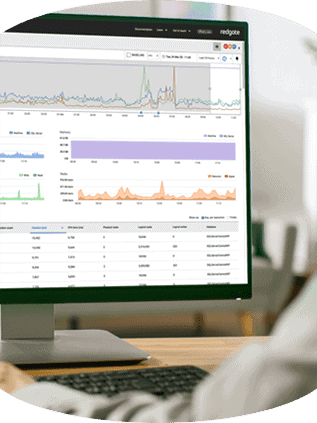
As teams evolve and estates change over the years, database environments can accumulate waste that is difficult to spot without the right visibility: cloud instances provisioned generously during a migration and never reviewed, or servers no longer in active use but never decommissioned.
Redgate Monitor automatically tracks cloud costs and resource consumption over time to highlight areas in need of optimisation. In practice, online workplace learning company GoodHabitz consolidated its data estate, reducing infrastructure costs by one third and eliminating dual running environments.
Redgate Monitor case studies show teams achieving up to a 75% reduction in monitoring time, freeing senior DBAs from routine checks and reactive investigation. For a senior DBA earning $120,000 to $160,000, this represents roughly $45,000 to $60,000 of redirected capacity per year. For a team of three, that equates to $135,000 to $180,000 annually that can be applied to higher value work, before accounting for avoided outages or downtime.
Redgate Monitor enables this shift by reducing the manual effort required to manage database performance and health through automated alerts, historical baselines, and contextual diagnostics. Teams spend less time checking dashboards and more time increasing resilience, reducing downtime risk, optimising infrastructure costs, supporting platform migrations and enabling new initiatives.


Operational risk increases when critical knowledge is concentrated rather than shared. When understanding of the database estate lives in individuals instead of systems, organizations are more exposed to absence, role changes, or shifting priorities.
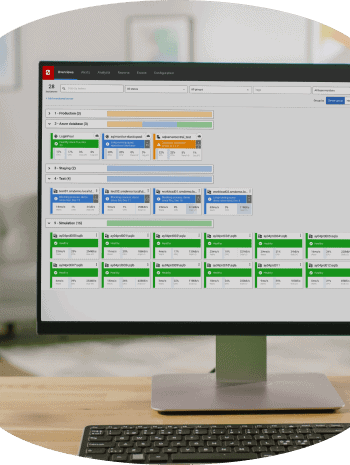
Redgate Monitor reduces that risk by embedding insight into a highly accessible, web-based interface. An estate wide overview highlights what needs attention, while AI assisted analysis explains issues and recommends actions in clear terms. The intuitive UI makes it easy for teams beyond DBAs, including developers, to see the impact of their work and contribute without lengthy onboarding.
A robust database monitoring solution like Redgate Monitor drives business value by proactively alerting your team of potential issues before they impact operations, reducing downtime and customer impact, and accelerating analysis and recovery efforts.
For security-conscious organizations managing complex database estates, Redgate Monitor Enterprise adds enterprise-grade governance, automated compliance capabilities, and high availability features that strengthen your security posture while dramatically reducing manual effort.
In doing so, it helps you maintain your competitive edge because your systems perform optimally, your data remains secure and compliant, and your IT teams focus on strategic initiatives rather than firefighting issues or getting frustrated with manual compliance processes.
The Redgate Monitor team can help and discuss your particular set up with the costs, implementation and support to get you up and running with Redgate Monitor faster and realize the return from your investment sooner. They can give you a bespoke quote based on your needs and your SQL Server environment. Ready to have a chat with one of our helpful and friendly team? Get in touch!
For over 90% of mid to large enterprises, a single hour of unplanned downtime costs more than $300,000, according to ITIC’s 2024 Hourly Cost of Downtime survey. Database issues can become customer facing incidents in minutes, making fast detection critical to protecting revenue and brand trust. In a Redgate survey of database professionals, teams using dedicated monitoring reduced time to detect issues by 28% and time to recover by 22%, limiting customer impact and disruption.
Redgate Monitor supports this with high quality alerting that surfaces genuine problems early. More than 65 preconfigured database-specific alerts and adaptive thresholds reduce noise, enabling teams to act before customers notice and issues escalate.
Strengthen operational resilience with Redgate Monitor Enterprise: High availability architecture with load balancers keeps monitoring running uninterrupted during system failures, so the tool your team depends on is available at the exact moment it matters most.
The State of the Database Landscape 2026 report found that 84% of organizations now run two or more database platforms, with 43% operating hybrid environments. That complexity increases migration risk and slows progress, as workload behavior and performance characteristics change across platforms and environments.
Redgate Monitor provides a single pane of glass across SQL Server, PostgreSQL, Oracle, MySQL and MongoDB, enabling teams to establish baselines before migration and maintain visibility throughout the transition. That continuity of insight reduces uncertainty, accelerates decision making and helps cloud migrations progress with greater predictability and control. It also helps teams right-size resources from the outset, using historical consumption data to avoid over-provisioning and keep spend aligned with actual demand.
During a performance incident, attention shifts away from planned work toward investigation and stabilization. Experienced specialists are drawn into diagnosis and explanation, reducing capacity elsewhere and increasing reliance on a small number of individuals. As time to root cause extends, disruption and opportunity cost build in parallel.
A monitoring tool shortens this cycle by making issues clearer earlier. With Redgate Monitor, AI Query Analysis identifies specific query performance problems and presents the underlying cause with recommendations on how to address the issue. AI Alert Analysis goes further by attaching cause and suggested remediation directly to alerts for blocking, deadlocks and long running queries at the moment they notify a user.
Regulatory compliance is one of the fastest-growing cost pressures in IT. A-LIGN’s 2026 Compliance Benchmark Report found that 97% of organizations now conduct two or more audits per year, with 1 in 4 stating the greatest challenge to their compliance strategy is conducting multiple audits. Each cycle demands evidence: configuration checks, permissions audits, proof of controls. For businesses still assembling that evidence manually, the cost in specialist time alone is significant and it recurs every cycle.
Automate compliance reporting with Redgate Monitor Enterprise: Access rights and permission changes are captured continuously as part of normal monitoring in Redgate Monitor Enterprise. The audit trail exists before anyone asks for it, timestamped and ready to export.
Organizations run infrastructure tooling in different ways. Some teams operate monitoring within their own environments and manage it directly. Others require a fully managed service that aligns with a SaaS first operating model. Redgate Monitor supports both approaches with a consistent pricing structure, allowing teams to choose what fits their organization without commercial compromise.
Redgate Monitor SaaS removes the overhead of running the monitoring platform itself. Redgate handles hosting and platform management, freeing teams to focus on database performance and higher value priorities such as AI data readiness, while aligning with SaaS procurement and operating models.
As teams evolve and estates change over the years, database environments can accumulate waste that is difficult to spot without the right visibility: cloud instances provisioned generously during a migration and never reviewed, or servers no longer in active use but never decommissioned.
Redgate Monitor automatically tracks cloud costs and resource consumption over time to highlight areas in need of optimisation. In practice, online workplace learning company GoodHabitz consolidated its data estate, reducing infrastructure costs by one third and eliminating dual running environments.
Redgate Monitor case studies show teams achieving up to a 75% reduction in monitoring time, freeing senior DBAs from routine checks and reactive investigation. For a senior DBA earning $120,000 to $160,000, this represents roughly $45,000 to $60,000 of redirected capacity per year. For a team of three, that equates to $135,000 to $180,000 annually that can be applied to higher value work, before accounting for avoided outages or downtime.
Redgate Monitor enables this shift by reducing the manual effort required to manage database performance and health through automated alerts, historical baselines, and contextual diagnostics. Teams spend less time checking dashboards and more time increasing resilience, reducing downtime risk, optimising infrastructure costs, supporting platform migrations and enabling new initiatives.
Operational risk increases when critical knowledge is concentrated rather than shared. When understanding of the database estate lives in individuals instead of systems, organizations are more exposed to absence, role changes, or shifting priorities.
Redgate Monitor reduces that risk by embedding insight into a highly accessible, web-based interface. An estate wide overview highlights what needs attention, while AI assisted analysis explains issues and recommends actions in clear terms. The intuitive UI makes it easy for teams beyond DBAs, including developers, to see the impact of their work and contribute without lengthy onboarding.
Whether you want more details about Redgate Monitor, a demo or information on best practices – get in touch with us.

Redgate has specialized in database software for over 25 years. Our products are used by 92% of the Fortune 100. 200,000 customers rely on Redgate worldwide.
Redgate offers comprehensive documentation and a friendly, helpful support team. An average 87% of customers rate our support 'Excellent'.