


Faster SQL Server Development Without the Downstream Risk
The database coding phase is where many of the decisions that determine code quality, review effort, handoff costs, and downstream deployment risk are first made. AI tools can help developers deliver SQL faster, but if this simply means more defects are discovered later in review, deployment, or production, then the cost and risk of database delivery increase with the pace of change.
The value of SQL Toolbelt Essentials for a SQL Server database team is that it both makes individual developers more productive and keeps deployment risk under control, as improved team productivity increases the speed and volume of database change.
When SQL Server database changes are a significant cause of production incidents, emergency fixes, and downtime, SQL Toolbelt Essentials will improve the DORA delivery metrics that track those outcomes. You should see increased development throughput (e.g., shorter lead time) and increased change stability (lower change failure rates and less unplanned rework).
The cost of database deployment disruption and downtime
Failed deployments are expensive, especially when they cause downtime, but also when they create unplanned rework such as hotfixes, and when they delay the release of new features because serious issues were only discovered close to deployment time.
What's the Cost of Downtime?
Gartner estimates an hourly outage or downtime cost of $200K-$500K for mid-market enterprises. Google then uses this to calculate an estimated "downtime cost per deployment" of $300K for 'medium' IT performers, rising to over $30 million for 'low' performers.
The best way to control the cost of downtime, delay, and disruption is not to slow development or decrease deployment frequency, but to detect and prevent problems as close as possible to the point where the code is written, when they are much easier and cheaper to fix. The code reaching review, test, and deployment becomes more reliable and resilient, lowering change failure rates and minimizing the cost and impact of any incidents.
This is the core principle behind SQL Toolbelt Essentials. It is designed to help teams maintain or increase deployment frequency while controlling deployment risk and cost by reducing both the change failure rate and the deployment rework rate.
The SQL TBE End-to-End Workflow
SQL Toolbelt Essentials will help simplify and standardize all the essential tasks of database development across the delivery workflow, from the point a feature or enhancement is selected for development, its design and coding, through to its safe deployment.
The ROI of SQL Toolbelt Essentials
Redgate estimates that teams using the full SQL Toolbelt Essentials workflow can save over $500K per year in costs associated with deployment failures that cause downtime, due to reductions in change failure rate and failure recovery time. This is calculated using a very similar methodology to that described in the DORA ROI of DevOps Transformation whitepaper and validated using direct customer experience.
This article focuses on the contributions to these savings at Stage 2 (Improve your code) of the workflow:
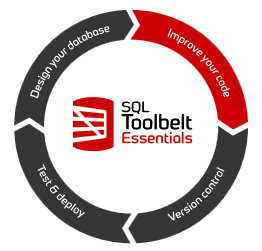
- Design your database – catch design flaws early, avoid costly rework
Design and share every database change so the team understands the intent, impact, and dependencies before coding starts. - Improve your code – reduce SQL coding costs, catch defects early
Team-based database development with AI-assisted SQL developer productivity plus built-in code quality checks and shared coding standards. - Version control – better issue prevention, faster issue diagnosis
Shared change visibility through version control with an audit trail of what changed, who changed it, and when. - Test & deploy – fewer deployment failures, faster recovery
Test database changes, prepare and test deployment and rollback strategies
How TBE improves database code during team development
During the coding phase of the development cycle, SQL Toolbelt Essentials will help a team of developers collaborate safely on database changes. Each developer works against their own local development database, but within a unified Toolbelt Essentials workflow that follows a Write-Optimize-Standardize pattern:
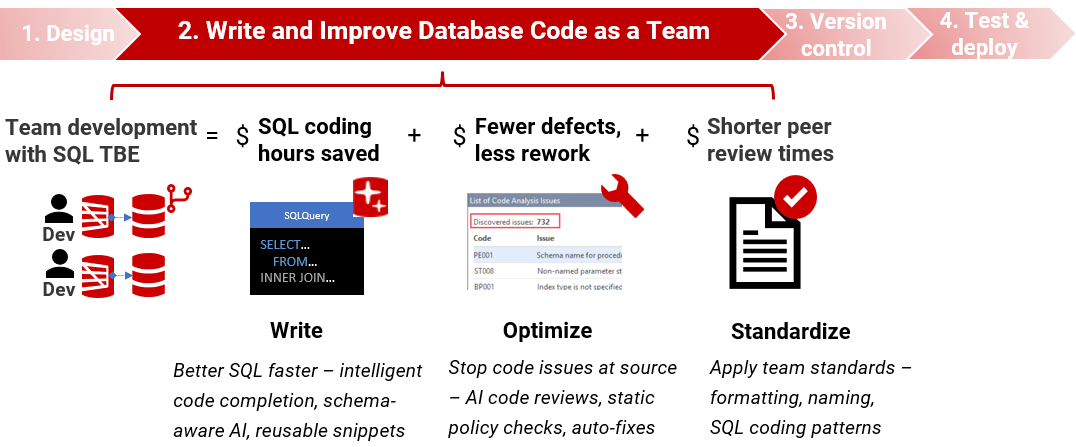
Write: deliver better SQL faster
Organizations can expect the code development features in SQL Toolbelt Essentials to save them around $100K per year in SQL coding time, for a team of ten developers.
This figure is based on Redgate customer feedback and internal research and excludes further gains from reduced review time, less rework, or faster onboarding. It is best understood as released engineering capacity rather than a direct budget reduction, and for most organizations, the value shows up in three ways:
- Higher team throughput – more planned development work delivered per sprint or release, with the same team.
- Engineering time released – less time spent on routine SQL coding, navigating unfamiliar SQL code, and duplicated effort.
- Lower opportunity cost – engineering capacity redirected into feature delivery, infrastructure modernization, performance work, and other higher-value priorities
Improving engineering productivity
Reducing routine SQL effort within a controlled development workflow will help the team move higher-value work through development faster. You can track this using the productivity metrics proposed by industry models such as the SPACE framework.
SQL TBE supports this by reducing the time developers spend getting from request to working SQL. SQL Prompt helps developers write and update SQL faster through intelligent code completion, schema-aware AI assistance, and reusable snippets for approved SQL patterns. SQL Search and SQL Dependency Tracker help developers understand existing code and dependencies faster.
The result is not just faster individual coding; it is more usable team capacity:
| Where time is lost... | TBE support | Value released |
|---|---|---|
| Writing complex query logic from scratch | SQL Prompt intelligent code completion, schema-aware AI assistance | Faster route to working SQL, ready for checking and standardization |
| Assessing unfamiliar legacy code | SQL Prompt AI explanation, SQL Search, SQL Dependency Tracker, | Faster onboarding, more accurate change impact assessments |
| Reinventing routine SQL logic | Hotkey snippets and team templates for approved SQL patterns | Less duplication, more consistent work |
Optimize: Catch and fix code issues at development time
If higher output pushes more defects into review, testing, deployment, or production, the gains from faster development are quickly lost to delays, rework, instability, and downtime. SQL Toolbelt Essentials helps prevent this by checking and improving SQL during development, while the code is still being written or refactored. The result is higher throughput without simply moving more risk downstream. This value shows up as:
- Reduced code rework costs – SQL issues are caught closer to source, when they are cheaper to fix. Teams will see fewer defects detected only during build, test, or later.
- Lower code handoff costs – less DBA or senior developer time spent correcting routine SQL issues, with fewer review iterations before approval.
- Lower change failure rate – fewer avoidable SQL issues reach pre-production or production, contributing to the estimated $500K per year lifecycle savings from reduced failure rates and faster recovery.
The value of catching code issues early
Often expressed informally as the Rule of 10, many industry studies support the principle that code issues are much cheaper to fix the earlier they are found. NIST, CISQ, and DORA all recommend moving quality checks earlier in the lifecycle through peer review, automation, and code policy checks during development.
SQL Toolbelt Essentials supports this through SQL Prompt’s AI code reviews and static code policy checks. These check SQL as developers write or refactor it, flagging common code smells that often cause performance problems, unpredictable behavior, or security concerns. It can auto-fix many issues before the code is committed.
| Where risk is created | TBE support | Value released |
|---|---|---|
| SQL issues found late, in pre-production reviews | SQL Prompt AI code analysis and static code policy checks | More issues are caught at source, before they delay delivery |
| Senior engineers lose time correcting avoidable SQL problems | In-context explanations of code issues with auto-fixes | Faster review, fewer iterations, lower-cost handoff |
| Legacy SQL that is hard to change and maintain | Assess and fix technical debt using code policy rules | Continuous optimization, lower maintenance costs |
Standardize: apply consistent coding standards
SQL Toolbelt Essentials improves team collaboration and reduces review and handoff friction by embedding agreed SQL formatting styles and good coding practices directly into the development workflow. The impact on improving overall software quality is underestimated, but often shows up as:
- More effective code reviews – less time spent on readability and consistency issues; more time spent on logic, performance, data impact and risk.
- Smoother handoff between teams – DBAs, Operations, security, compliance and performance reviewers receive SQL that is easier to understand and approve.
- Easier maintenance and troubleshooting – consistent SQL is easier to read, compare, debug and change safely.
Making code reviews more valuable
Industry research into code review at Microsoft explains why shared and automated coding standards make code reviews more valuable: it allows reviewers to focus on code improvement, defect detection, knowledge transfer, and maintainability rather than being distracted by code style issues.
SQL Toolbelt Essentials supports this via SQL Prompt's built-in formatting options and styles, which make it easy to define and implement a standard SQL style across your team. Its code snippets apply standard patterns for stored procedures, functions, error handling, headers, transaction handling, logging, and other common tasks.
As a result, developers spend their review time explaining why a different design pattern might work better, sharing domain context, or suggesting optimization tricks rather than formatting code so they can "read it properly" or fixing non-standard or missing logging or error-handling logic.
| Where friction appears | TBE support | Value released |
|---|---|---|
| Each developer formats code "their way." | Shared SQL Prompt formatting styles | Reduced cognitive load. More review time spent on logic, impact, and risk |
| Inconsistent naming, aliasing, object qualification, casing | SQL Prompt refactoring actions | Code is easier to read, compare, troubleshoot, and change safely |
| Repeatable SQL structures are missing or inconsistent | Reusable code snippets for approved SQL patterns | More resilient and maintainable code. |
The next workflow stage: version control
Developers, each working freely on their own local database, follow the Write-Optimize-Standardize workflow described above during coding. The next phase is tracking and coordinating team changes, including merges and pull requests, through the version control system.
Following the best practice of working in small batches, each developer regularly commits completed work to the team's shared version control repository, directly from their IDE, gets the latest changes from the rest of the team, and reviews others' changes before conflicts become harder to resolve. This simplifies team coordination and makes parallel database development safer.
This will have a significant influence on the overall speed and efficiency of development, which should be reflected in higher team velocity: more database work completed per sprint with fewer pipeline disruptions caused by merge conflicts. Coordination, tracking, and auditing of database changes through version control using SQL Source Control are covered in a subsequent article.
How to Measure the ROI of SQL Toolbelt Essentials
The important point is that the value can be measured, and teams can prove that SQL Toolbelt Essentials improves team productivity and that faster database development translates into safer, more predictable delivery. Teams should start by establishing baseline values for the delivery outcomes they want to improve, usually at the service or application level. They can then track leading indicators during development to connect development workflow improvements to delivery outcomes.
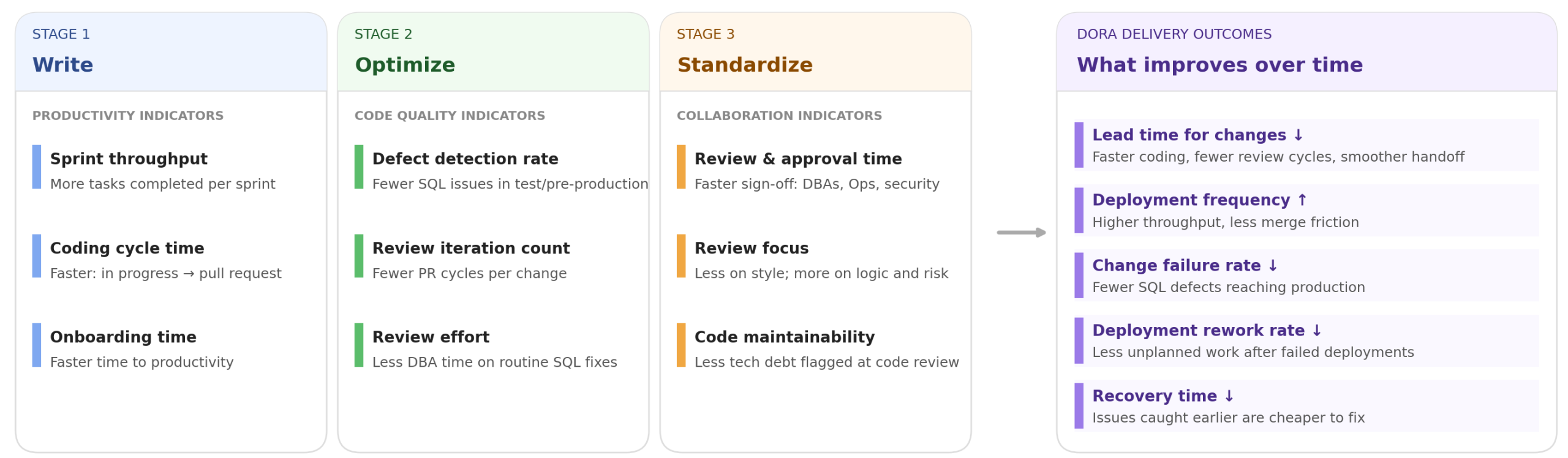
Delivery outcomes
The outcome metrics suggested below are DORA's core performance metrics for software delivery. The first three measure delivery throughput, which should increase, and the last two deployment stability, all of which should decrease:
- Lead time for database changes
- Deployment frequency
- Failed deployment recovery time
- Change failure rate
- Deployment rework rate
When teams adopt the SQL Toolbelt Essential workflow, these metrics should start to indicate that database delivery is both getting faster and more reliable.
Teams can also predict and measure ROI using Redgate's SQL Toolbelt ROI calculator. The precise ROI depends on each team's baseline: how often they deploy, how often database changes fail, how expensive downtime is, and how much rework follows a failed deployment.
Development indictors
If SQL Toolbelt Essentials helps developers write SQL faster, catch issues earlier, apply shared standards, and coordinate database changes more effectively, the teams should see that first by tracking some standard development metrics for team productivity and collaboration, and code quality. This might include SQL coding hours saved, higher team productivity (more requests completed per sprint), reduced number of 'iterations' before a pull request is accepted, lower review time, and fewer defects found only in testing or deployment.
Over time, those improvements should contribute to shorter lead times, lower change failure rates, and reduced recovery times after failure.
Summary
With SQL Toolbelt Essentials, the foundation of higher productivity is safer, more efficient team development, helping teams accelerate database development without losing control of database change.
During the coding stage of the development cycle, it will help developers write, understand, and update SQL faster with AI-assisted tooling, while shared standards, code checks, source control, and reliable deployment workflows make each change easier to review, track, test, and release safely.
The quality of the code that reaches testing and DBA review is no longer so dependent on who wrote it, because shared standards and templates encourage good practices, and code reviews catch common design mistakes and vulnerabilities at source, when they are much easier and less costly to fix.
The result is not just individual productivity, but a more scalable team workflow: shorter lead times, less avoidable rework, fewer late-stage surprises, and lower operational risk.
This document contains proprietary information and is protected by copyright law.
Copyright © 2026 Red Gate Software Limited. All rights reserved
Tools in this post
SQL Toolbelt Essentials
10 simple tools for fast, reliable and consistent SQL Server development.
You may also like

Webinar
SQL Server-Entwicklung neu gedacht – mit SQL Toolbelt Essentials
Mit den richtigen Tools den Datenbank-Alltag meistern. In diesem kompakten On-Demand-Webinar zeigen wir Ihnen, wie Entwicklungsteams ihre tägliche Arbeit mit SQL Toolbelt Essentials deutlich effizienter gestalten – von der ersten Codezeile bis zum sauberen Release.

Article
SQL Prompt Product Updates – June 2026
SQL Prompt’s May releases focused on a new Redgate Data Modeler integration, a unified Toolbelt Essentials installer flow, and several improvements to Prompt AI reliability. Browse your database in Redgate Data Modeler directly from Object Explorer SQL Prompt v11.3.15 adds an Open Data Modeler option to the Object Explorer context menu in SSMS. Right-clicking any database now gives you a direct shortcut to open it in Redgate Data Modeler in your default browser. Data Modeler is now part of SQL Toolbelt Essentials, so if you’re already a Toolbelt customer you’ve got access. This integration means you can jump straight from
Workshop
Redgate Workshop Wien – Reliable Releases
Zuverlässige Datenbankänderungen bereitzustellen gehört zu den größten Herausforderungen in der Entwicklung. Dieser Workshop richtet sich an Entwicklerinnen und Entwickler, DBAs sowie DevOps-Fachkräfte, die praxisnahe Methoden für schnellere und sichere Releases mit SQL Toolbelt Essentials oder Flyway kennenlernen möchten. Nutzen Sie die Gelegenheit, praxisnahe Techniken für zuverlässige Datenbank-Releases kennenzulernen und direkt anzuwenden.

Article
How to document multiple SQL Server databases using SQL Doc and PowerShell
Phil shows how to use SQL Doc, PowerShell and a SQL Doc XML Project file to document multiple databases at once.

Article
SQL Prompt Product Updates – February 2026
SQL Prompt’s latest releases focus on stability and quality improvements, particularly around our AI features and SSMS 22 compatibility. AI reliability improvements We’ve made several improvements to how SQL Prompt AI handles real-world conditions. If SQL Prompt is unable to retrieve your database schema, AI requests will now continue without schema-awareness rather than failing silently — with a warning displayed in the Prompt AI window so you know what’s happening. We’ve also fixed an issue where intermittent schema retrieval failures required you to close and re-open the Prompt AI window to recover, and resolved a bug where a failed AI
Webinar
Sechs Strategien zur Effizienzsteigerung Ihrer SQL Server-Datenbankentwicklung mit SQL Prompt und mehr
Entdecken Sie sechs praktische Ansätze zur Produktivitätssteigerung mithilfe von Redgate-Tools wie SQL Prompt und SQL Toolbelt Essentials.
Loading comments...