


How dedicated database monitoring protects customer experience and reduces operational risk
In brief
Many outages, slowdowns and failed transactions start in the database, often well before anyone outside the data team knows something’s wrong.
By the time they do, customers are already affected: payments fail, services stall and people can’t do what they came to do. The organisations that keep this risk under control close three gaps. They stop problems before they disrupt customers and the services they depend on. They find the cause in minutes, and fix it quickly. And they govern their data in a way that it stays consistently audit ready. This article looks at what each gap costs, and what closing it looks like.
Why database performance is a business risk
Almost every interaction with your business depends on a database. Signing in, searching, paying, checking a balance or pulling up a patient record all start with a request that has to be answered fast.When the database responds quickly, nobody notices. When it slows down, everything built on it slows too. A payment doesn’t go through, a portal won’t load, an order fails at checkout. The causes are usually ordinary: a slow query, one process blocking others, or a change released at the wrong moment. The effect on the people trying to use your services is anything but.
What does an hour of disruption cost?
Those effects have a measurable price. ITIC’s 2024 survey found that an hour of downtime costs more than $300,000 for over 90% of mid size and large enterprises. Some 41% put the cost at between $1 million and more than $5 million an hour, before any legal fees or regulatory penalties.
Industry averages only go so far, though. The more useful question is what your last major incident cost in failed transactions, refunds, overtime and customer complaints. Even a few incidents a year add up, and shortening each one reduces the exposure your business carries.
Gap 1: Customers are affected before the team knows
Without dedicated monitoring, the database team often hears about a problem from the people it’s already hurting. A customer can’t complete a payment. An order fails at checkout. A clinician can’t open a patient record mid-consultation. Hundreds of people can’t log in to their account.
Each of those is someone who couldn’t do what they came to do, and the number grows every minute the problem goes unnoticed. In sectors such as healthcare, banking and energy, the impact goes well beyond inconvenience.
What good looks like: the team spots slowdowns and capacity issues early and fixes them before they disrupt customers or the services they rely on.
Gap 2: Knowing something’s wrong, but not why
General observability platforms are good at showing that a service is slow and pointing towards the database. They’re less good at showing why. The database team still has to find the query, the blocking process or the change responsible, and that’s often where recovery time is lost while customers wait.
What good looks like: the cause is visible straight away, so the fix starts in minutes rather than after hours of investigation.
Gap 3: Proving who has access to what
Operational risk also covers what happens when an auditor, regulator or customer security questionnaire asks for evidence. In many organisations, that exposure lands on a named executive. If the answer depends on manual checks or homegrown scripts, every request turns into a project.
Access controls are only one part of security, but they’re one of the first things investigated after a breach, and IBM’s 2025 Cost of a Data Breach report puts the global average cost of a breach at $4.44 million. For organisations working under DORA, NIS2 or NYDFS, being able to prove access quickly isn’t optional.
What good looks like: access and configuration evidence is recorded automatically, so questions are answered the same day.
How Redgate Monitor closes those gaps
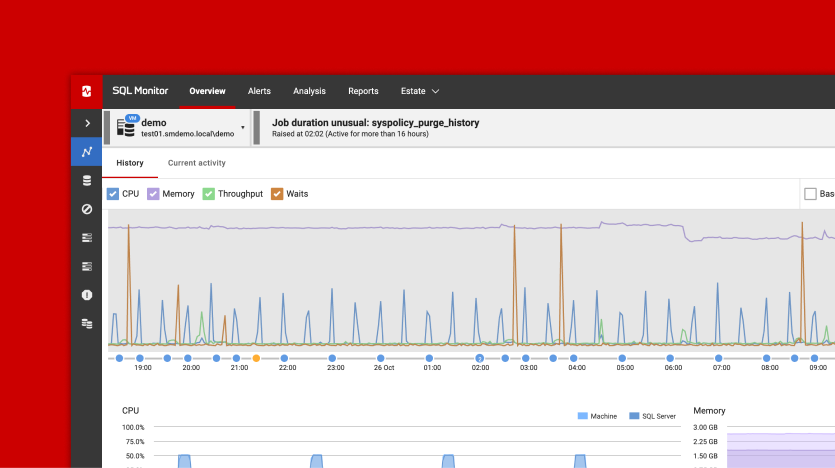
- Stopping problems before they reach customers. Redgate Monitor alerts on slowdowns, blocking and capacity problems across your estate, so the team can act before customers are affected.
- Finding the cause. Because it’s built specifically for databases, Redgate Monitor goes past “the database is slow” to the query, process or deployment responsible. In Redgate’s 2020 State of SQL Server Monitoring survey of 971 database professionals, teams using a dedicated monitoring tool detected deployment issues 28% faster and recovered 22% faster.
- It’s quick to onboard. G2 users named it Most Implementable in 2026. Because it’s built specifically for databases, Redgate Monitor goes past “the database is slow” to the query, process or deployment responsible. In Redgate’s 2020 State of SQL Server Monitoring survey of 971 database professionals, teams using a dedicated monitoring tool detected deployment issues 28% faster and recovered 22% faster.
- Proving access. Redgate Monitor Enterprise tracks permissions across your SQL Server estate and checks configuration against CIS Benchmarks®. The Center for Internet Security® has certified those checks as accurate, so the results stand up with auditors, and your DBAs aren’t pulled away from other work to produce them.
What resilience looks like at 1,400 databases
Republic Bank runs 1,400 databases on Redgate Monitor with 99.7% server uptime. As its SVP put it, “that is the ROI right there.” TruStone Financial cut its permissions reporting time by 95%. As the team describes it, “In just 2 minutes, I know exactly which permissions are in place.”Outside financial services, Dutch e-learning company GoodHabitz used Redgate to consolidate its estate and cut infrastructure costs by a third. Its CTO said Redgate’s tools “acted like a virtual DBA, giving us clarity, reducing complexity and enabling data-driven decisions.”
See what a shorter incident is worth to your estate
Every incident caught earlier or fixed faster cuts what downtime costs you, and every audit answered from records you already keep saves time and pressure on your team.
The Redgate Monitor ROI calculator puts a figure on that for your own estate. Add details about your estate and current tooling, and it estimates the return on switching to Redgate Monitor.
This document contains proprietary information and is protected by copyright law.
Copyright © 2026 Red Gate Software Limited. All rights reserved
You may also like

Blog
PostgreSQL in Redgate Monitor: configuration advice, backup monitoring, Windows support and AlloyDB

Blog
Loading comments...