PASS Summit 2026 Coming To Three Cities|Register now

Report

AI Edition - 2026 State of the Database Landscape

AI adoption in database management has nearly tripled in a year, however individual gains are not translating into organizational control.

The AI edition of the ‘State of the Database Landscape’ report reveals where AI is delivering real value, and where fragmented usage, weak governance, and inconsistent practices are creating risk and impacting delivery.

Download the mini report

The 2026 State of Database Landscape - AI edition report cover

Finding 1

AI is scaling faster than the practices needed to govern it

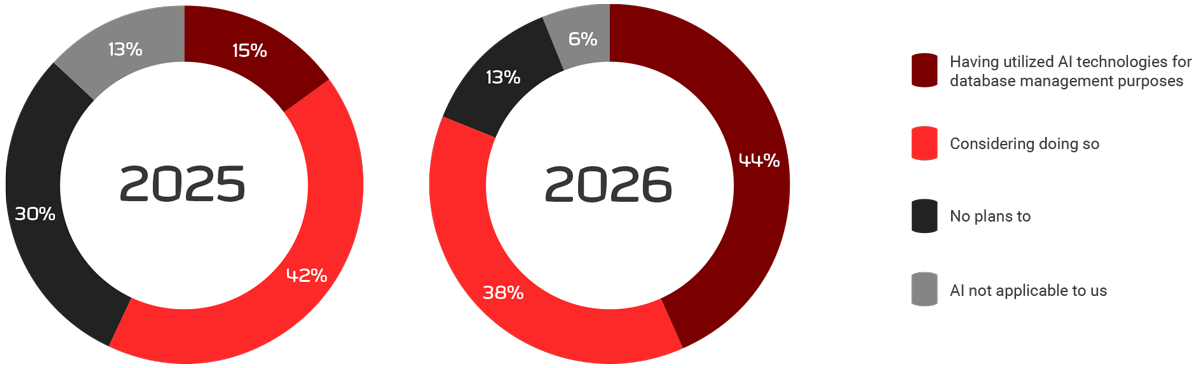
AI usage in database management has nearly tripled year-on-year (15% to 44%), becoming embedded in core tasks across complex, multi-platform environments. However, this rapid adoption is increasing the pace of change and data reuse before consistent governance and data practices are in place. As a result, many of the pressures associated with AI adoption are surfacing downstream as data quality, security, and compliance issues.
AI can be the good and the bad here. The concern is mainly how people deal with it (like uploading confidential information to ChatGPT), or when you give it too much power. Granting AI the permissions to automatically fix everything means it can potentially also cause huge damage.Ben Weissman

Ben Weissman

CEO, Solisyon GmbH

AI adoption within database management
AI adoption within database management

Toptip1

How to scale delivery, without scaling risk

This whitepaper uncovers how secure, automated database change management resolves that tension and explains why growth fails without safeguards.

Learn more

Finding 2

AI adoption has accelerated rapidly

Nearly half (44%) of organizations now use AI in database management, with adoption highest in large, cloud-based, multi-platform environments where complexity is greatest. Investment is also significant, with around half spending over $100,000 and almost a quarter of large enterprises exceeding $1 million. Rather than reducing complexity, AI is increasingly being used to help manage environments that are already difficult to operate at scale.
Despite the risks, the potential benefits of AI are huge. Companies that don’t explore and use AI tools risk falling behind. The key is finding the right balance between making the most of AI’s capabilities and managing its risks.Jeff Foster

Jeff Foster

Director of Technology and Innovation, Redgate

~50%of organizations have invested more than

$100,000in AI in the past year

Toptip2

AI and databases: where is it actually being used?

With AI tools now embedded across database work, from query optimisation and test data generation to anomaly detection and developer support, it can be hard to know where to start. This article cuts through the noise, examining how AI is genuinely being applied across database environments today, and what that means for the professionals managing them.

Learn more

Finding 3

AI delivers measurable benefits

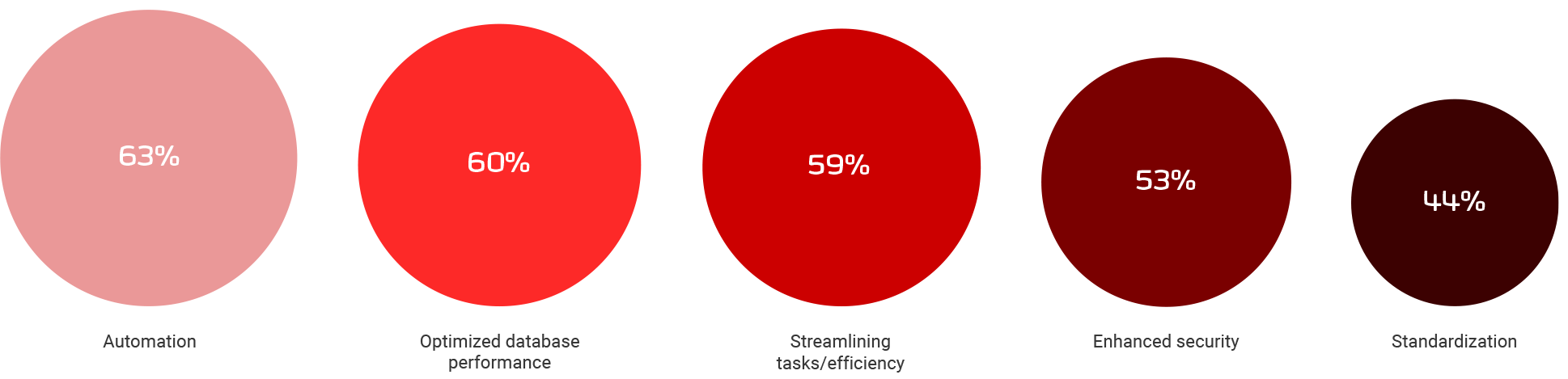
AI is now widely used across core database activities, including data quality (51%), schema design (51%), and automation (50%), with 99% of organizations reporting at least one benefit. The most common gains include automation (63%), improved performance (60%), and efficiency (59%), alongside 76% reporting cost savings. These results demonstrate that AI is already delivering tangible operational and financial value.
The places I’m genuinely seeing AI help today are the parts of database work that usually take a lot of time and troubleshooting or debugging. It’s useful for getting to a solid first draft quickly, for translating noisy outputs into something understandable, and for giving engineers a structured starting point during troubleshooting.Advait Patel

Advait Patel

Senior Site Reliability Engineer, Broadcom

Benefits reported
Benefits reported

Toptip3

How to turn AI's measurable benefits into sustainable business value

Nearly all organizations are seeing gains from AI, but realising those benefits at scale requires more than the right tools. Explore how smarter database management can help teams move from isolated productivity wins to scalable, secure AI that consistently delivers across the business.

Learn more

Finding 4

Organizations need stronger foundations to sustain AI adoption

Despite rapid adoption, core practices remain inconsistent, with 39% still relying on manual approaches to test and deploy database changes and only 23% using formal data governance frameworks. As AI accelerates the rate of change, these gaps make it harder to validate, track, and manage changes safely. This creates a growing mismatch between the speed of AI-driven development and the practices needed to support it at scale.
Everyone wants to move faster with AI, but few are truly ready for it. It isn't just about algorithms - it's whether your data, systems, and teams are prepared to support intelligent automation safely and effectively.Jeff Foster

Jeff Foster

Director of Technology & Innovation, Redgate

39%still test and deploy database changes manually

23%use formal data governance or quality frameworks

Toptip4

How to build solid foundations for successful AI implementation

Rapid AI adoption only delivers if the data, systems, and teams underneath it are ready to support it. This article sets out the four layers of data readiness that turn AI from a fragile dependency into a reliable engine for progress — from schema traceability and compliant test data, to real-time performance visibility and stronger team practices.

Learn more

Finding 5

AI risks and concerns remain unresolved

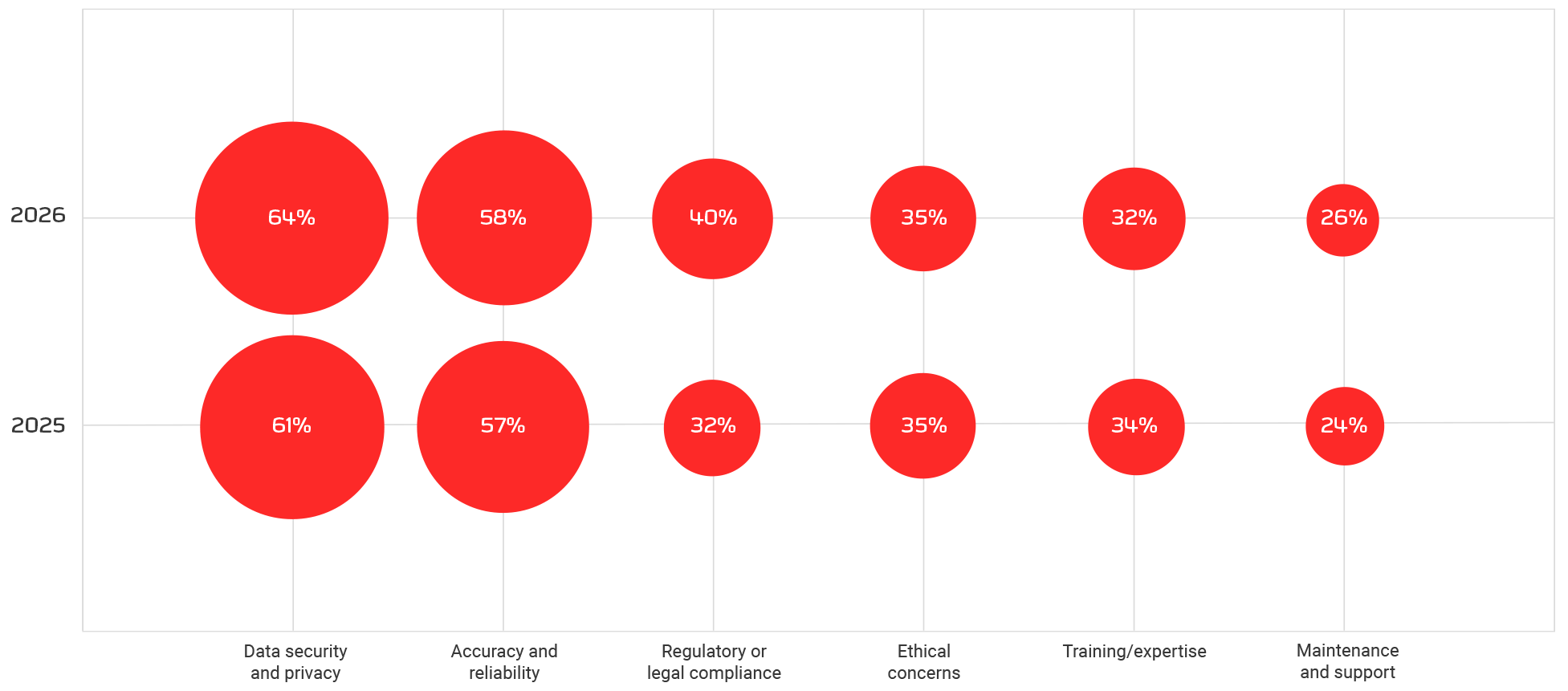
Concerns around AI remain widespread, with data security and privacy cited by 64% of respondents and regulatory compliance concerns rising to 40%. At the same time, 58% of organizations accept higher risk as a trade-off for efficiency gains, highlighting a growing tension between speed and control. This reflects a broader pattern where AI is both helping to manage risk and introducing new challenges.
There’s still a trust issue with AI... It’s just as confident even when it’s completely wrong.Deborah Melkin

Deborah Melkin

Financial Services

Most common concerns over AI use
Most common concerns over AI use

Toptip5

How to close the compliance gap without compromising test data quality

Most masking scripts only catch what you thought to account for — and "most of it" doesn't hold up in an audit. This on-demand session shows how AI can be used to find the gaps in your current approach and generate production-quality test data, without your data ever leaving your environment.

Watch the webinar

Finding 6

AI is reshaping roles faster than organizations are adapting

AI is changing how work is distributed across teams, with 49% of respondents reporting a disconnect between their role and day-to-day responsibilities. At the same time, 76% of organizations now provide formal AI guidance, while nearly half report hiring fewer junior staff. These shifts suggest that AI is not only changing how work is done, but how skills and experience are developing over time.
AI is already reshaping entry-level tech in ways most organizations haven't planned for. The real question isn't just about roles changing but what the bridge looks like when experienced professionals move on and there are fewer junior people coming through to fill those gaps.Kellyn Gorman

Kellyn Gorman

Advocate, Redgate Software

49%say there’s a disconnect between their job description and their day-to-day work

76%of organizations now provide formal AI guidance – up from 52% last year

49%are hiring fewer junior or entry-level staff because of AI adoption

The 2026 State of Database Landscape - AI edition report cover

Download the report

AI Edition - 2026 State of the Database Landscape