


Redgate Assistant and the path to Autonomous Operations
Ask an AI assistant to explain why a query is running slowly and it can help a database professional reach an answer faster. Give that same assistant the ability to change the database and the stakes change. The closer AI gets to taking action, the greater the consequences of incomplete context, inappropriate access or an incorrect decision.
AI adoption in database management is already accelerating. Redgate’s 2026 State of the Database Landscape research found that 44% of organizations now use AI for database management, compared with 15% a year earlier.
The value is becoming clearer too. Among organizations already using AI for database management, 46% report significant productivity gains and 76% report significant cost savings. For CTOs and technology leaders, the question is therefore no longer simply whether database teams will use AI. It is how to expand that value without losing control of the systems and data their businesses depend on, particularly when security and privacy remain the leading concern, cited by 64% of respondents.
But what if a database assistant could do more than help individual professionals complete tasks faster? What if it could carry context across the workflow, extend scarce expertise across the team and take on more of the work within boundaries the organization controls?
This is Redgate’s vision for Autonomous Operations, and Redgate Assistant is the latest step on that journey.
Enabling reliable database AI with context and control
AI coding tools have demonstrated what becomes possible when AI understands the task and works within established workflows. Teams can move faster, reduce routine work and focus scarce expertise on higher-value priorities. Applying AI to database management, however, requires a different approach.
Databases are systems of record. They contain persistent, often sensitive information and support critical applications and services. An incomplete or poorly informed recommendation can affect performance, availability, data integrity, security and compliance, with potentially significant operational and financial consequences. Database work also frequently takes place against live, stateful systems where changes may be difficult to reverse cleanly.
Effective decisions therefore depend on more than general SQL knowledge. AI needs to understand how the environment is structured, how workloads behave, which dependencies exist and what organizational controls apply. Without that context, teams must assemble and validate the relevant information themselves, limiting both the usefulness of AI and the confidence they can place in it.
Redgate Assistant: purpose-built AI for database teams
Redgate Assistant brings purpose-built, context-aware AI into the Redgate tools database professionals already use. Its guidance is grounded in the database environment and task at hand, reducing the need for users to repeatedly assemble and explain complex context before AI can provide useful support.
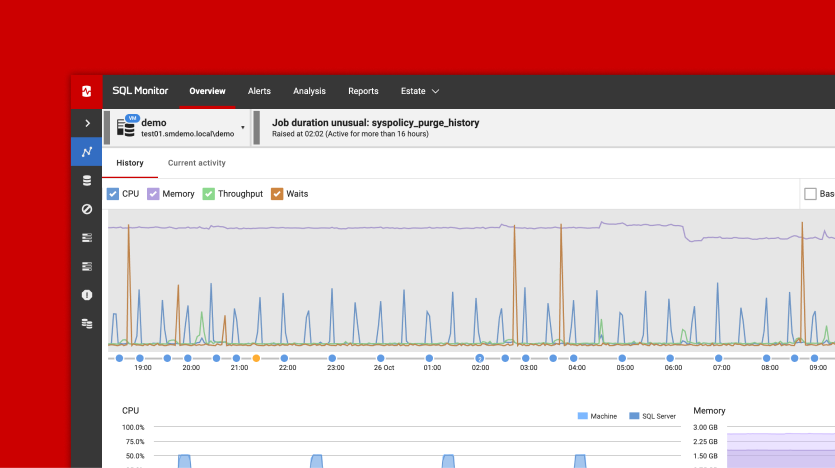
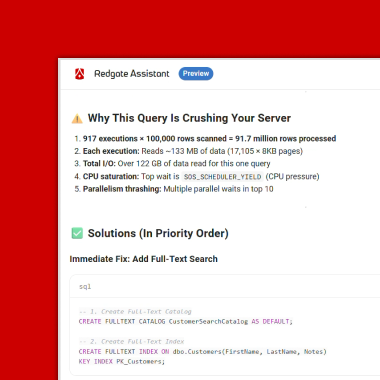
In Redgate Monitor, the Assistant helps professionals investigate performance issues, interpret the available evidence and identify where to focus. In SQL Prompt, it helps developers understand unfamiliar databases, improve SQL code and complete routine work within their existing workflow.
For technology leaders, the value extends beyond your teams completing individual tasks faster. Redgate Assistant can reduce fragmented investigation, make scarce expertise go further and give teams a more consistent starting point for database work.
From assistance to Autonomous Operations
Redgate Assistant’s current capabilities are the latest step in Redgate’s broader journey towards Autonomous Operations. As it develops, Redgate Assistant will move from responding to user prompts to proactively identifying early warning signs, such as queries running off-pattern, before supporting more of the investigation itself. Over time, that progression can extend from identifying and explaining likely causes to proposing responses, verifying outcomes and, where appropriate, carrying out approved actions.
Building towards that future rests on three foundations.
- Database-aware assistance: Database decisions depend on context that general-purpose AI does not possess automatically. Redgate Assistant is grounded in the environment and task at hand, allowing it to provide more relevant guidance today and maintain the understanding needed to support more of the workflow over time.
- Connected AI across database workflows: Database work rarely begins and ends in one tool. Redgate is building one Assistant, beginning in Monitor and SQL Prompt and expanding, over time across Flyway and the wider Redgate portfolio, so context and intelligence can connect more of the database lifecycle. This will allow assistance to follow work more consistently from investigation towards resolution.
- Safe, governed automation: Greater responsibility requires stronger access controls, accountability and verification. Redgate’s approach builds on existing database permissions and gives AI activity a distinct, auditable identity. Coming next, Verified Remediation would test proposed changes against a safe database copy before presenting the results for professional review.
This progression will not look the same for every organization or task. Each use case can advance according to the evidence available, the organization’s confidence and the consequences of an incorrect action. Proven, repeatable work may require less intervention over time, while consequential decisions continue to receive closer oversight. This allows Redgate Assistant to assume greater responsibility where the context, evidence and controls support it.
From performance alert to verified response
Consider a critical database slowing down during a period of high demand. Monitor raises an alert, but the team must still determine what changed, which queries are contributing and what action is appropriate.
Today, Redgate Assistant can help a professional investigate the evidence, identify where to focus and explain likely causes. It turns the alert into a clearer starting point and reduces the manual work required before the team can decide what to do next.
As Redgate Assistant develops, the same workflow could continue beyond investigation. It could propose a response and, through Verified Remediation, test the proposed change against a safe database copy. The professional would review evidence of how the change behaved before deciding whether it should reach a live environment.
The workflow would move from alert to investigation, verification and action while keeping professional oversight aligned with the consequences of the decision.
Scaling database expertise with control
For technology leaders, the opportunity is not simply to have your teams automate more database tasks. It is to expand team capacity, make scarce expertise go further and improve the speed and consistency of work supporting critical systems.
Embedding AI within trusted tools and controls also provides an alternative to fragmented adoption and professionals passing sensitive database information into disconnected general-purpose tools.
Autonomous Operations does not require every task to become autonomous or every organization to progress at the same pace. Responsibility can expand incrementally where value has been demonstrated, safeguards are in place and confidence has been earned.
Redgate Assistant delivers practical value now while creating the path towards that future. Control is not the brake on Autonomous Operations. It is what enables organizations to give AI greater responsibility with confidence.
This document contains proprietary information and is protected by copyright law.
Copyright © 2026 Red Gate Software Limited. All rights reserved
Tools in this post
You may also like

Article
Build vs Buy in the Age of AI
Every DBA has a toolbox they trust that often includes a folder of scripts refined over a decade, mostly a handful of DMV queries. These queries answer “what’s slow right now” faster than any dashboard, and a working knowledge of the environment that took years to build. So, when a new AI tool promises to answer the same questions in plain English, the first reaction is usually suspicion rather than excitement. That suspicion should be expected, but it also means a lot of DBAs are making an unspoken decision without really weighing in and kicking the tires. There’s a comfort
Article
Redgate Assistant and the path to Autonomous Operations
Ask an AI assistant to explain why a query is running slowly and it can help a database professional reach an answer faster. Give that same assistant the ability to change the database and the stakes change. The closer AI gets to taking action, the greater the consequences of incomplete context, inappropriate access or an incorrect decision. AI adoption in database management is already accelerating. Redgate’s 2026 State of the Database Landscape research found that 44% of organizations now use AI for database management, compared with 15% a year earlier. The value is becoming clearer too. Among organizations already using
Loading comments...