During development you'll occasionally need an undo script that drops a group of tables, or you might need to truncate a group of tables and then insert fresh data in order to run some tests. Unless you perform the required actions in the correct dependency order, you'll be tripped up by foreign key constraint violations. This article provides a SQL function that returns the list of tables in the correct dependency order. Read more
This article demonstrates one way to do branch-based database development with Flyway, using GitHub to manage the branches and Flyway configuration files to allow Flyway to switch smoothly between databases, when we move between branches in GitHub. Read more
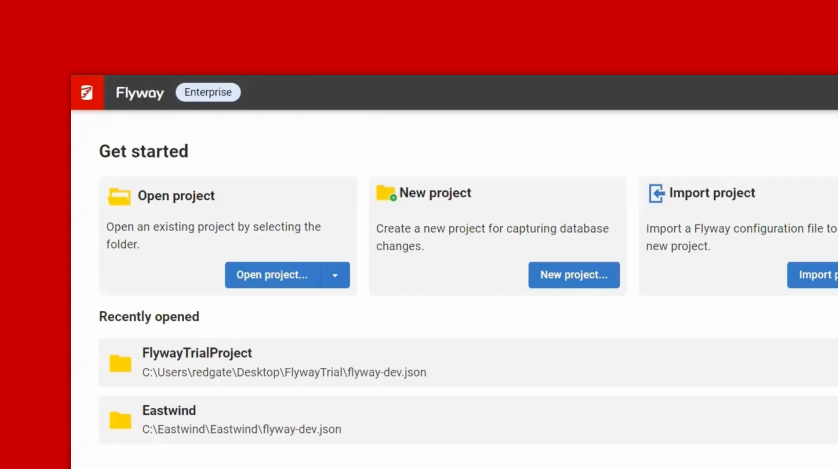
This article provides a simple demonstration of how a small team of developers might set up a Flyway Desktop project to manage, automate, and control database development. Read more
For those new to Flyway Desktop, this article takes a strategic overview of the components of a Flyway Desktop project, how to set up a project for team-based development work, and how we can use the tool in conjunction with a version control system and CI servers to manage a database development and release process. Read more
This series of articles describes a path you can take to transforming an existing, manual and error-prone database development and release process into an automated and reliable Database DevOps 'pipeline', starting here with an overview of what we set out to achieve, and the people, processes and tools involved. Read more
As a database gets larger, and development more complex, so it becomes increasingly necessary to be able to search for strings in the source files and the database itself. Maybe you need to find when a table first got created, when a foreign key was added, or to find out which tables lack documentation. I'll show you how to answer these sorts of questions by running simple 'wildcard' searches on your Flyway migration files, or source files, as well as more targeted searches on certain parts of your database model. Read more
If you save a metadata 'model' for every new version of a database created by Flyway, you can compare the current model to the previous one to see what changed. In turn, you can then generate a database E-R diagram that highlights the changed objects, instantly making those changes visible to other team members. Read more
How does one check that a database is definitively at the version that Flyway says it is? Or that a test teardown procedure leaves no trace in the database? Or verify that an undo script returns a database's metadata to that state it should be in for the version to which you're rolling back? This article shows how to do high-level version checks, by comparing JSON models. Read more
If you can generate a file-based (JSON) model for each new version of a database, produced by a Flyway migration, then you have an easy way to run simple reports to help you search, list, and understand the structure of these databases. I'll show how to produce the models using PowerShell and then run some queries against them to generate the reports. Read more
How to integrate Flyway database development with Source control, so that you can track what changes were made and who made them as well as which objects changed between versions, and how. Read more