


5 Database Monitoring Tips Every DBA Should Use to Reduce Firefighting
In a recent webinar I hosted with my colleague Chris Hawkins, Inside a DBA’s Day: What Really Happens and How to Stay Ahead, we talked through the realities of a typical DBA day and the practical ways teams can stay ahead of issues rather than constantly reacting.
For many DBAs, the day doesn’t start with coffee. It starts with an alert. A report is suddenly slow. An application query is timing out. CPU has spiked overnight and someone is asking why. Before you’ve even opened your monitoring tools, you’re already in troubleshooting mode.
Furthermore, according to Redgate’s State of the Database Landscape report, many database teams are managing more instances and complexity than ever before, while still being expected to resolve issues faster and with fewer resources.
Based on that discussion, here are five practical database monitoring tips that can help DBAs stay ahead of problems and spend less time firefighting.
Don’t let scripts be your monitoring strategy
PowerShell scripts and DMV queries are powerful tools, but over time they can become inconsistent and heavily dependent on the person who originally wrote them. Many start as quick fixes and gradually become difficult to maintain.
Scripts are excellent for tactical tasks, but they shouldn’t form the foundation of your monitoring approach. A more effective strategy is to use a dedicated monitoring solution that provides continuous visibility, retains historical data, and allows teams to collaborate around incidents rather than simply reacting with scripts whenever something breaks.
Start your day with instant clarity
When you’re responsible for dozens or even hundreds of database instances, you don’t have the luxury of manually checking everything to find what matters. You need immediate visibility into the overall health of your environment.
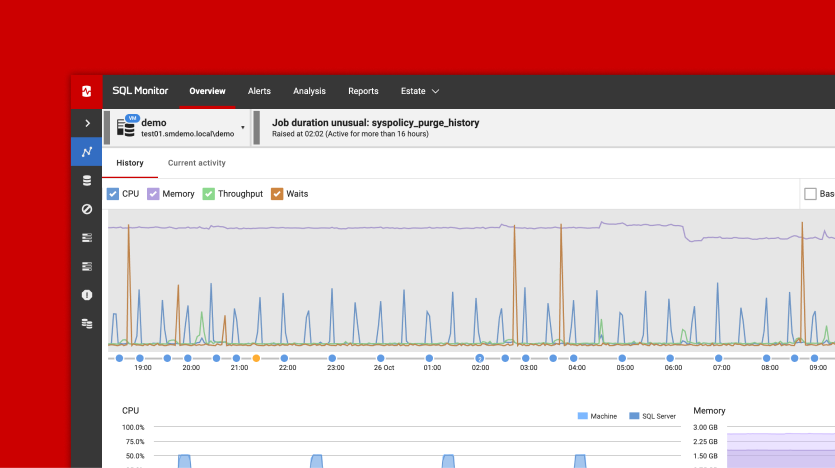
A well-designed high-level dashboard lets you quickly see which servers are critical, which are degraded, and which are running normally. Instead of spending time hunting for issues, you can immediately focus on the servers that have the greatest business impact.
Make alert history work for you
Often, by the time you log in and investigate an alert, it has already stopped firing. That doesn’t necessarily mean the problem has gone away. Issues such as deadlocks, blocking, or temporary connectivity failures can disappear quickly but still point to underlying problems.
What matters is the context around the alert. You need to know what was running at the time, when the issue occurred, what might have changed beforehand, and whether someone on the team has already investigated it.
Correlate performance with change
One of the first questions during an incident is often simple: “What changed?”
You might notice throughput spikes, CPU increases, or a query plan suddenly shifting from an index seek to a clustered scan. Without context, identifying the cause can quickly become guesswork.
Monitoring tools that track performance metrics over time and surface alerts alongside database activity help DBAs understand what was happening when the issue occurred. When deployments, configuration updates, or schema changes are visible alongside performance data, it becomes much easier to connect the dots and identify the root cause of a problem quickly.
Use built-in intelligence to speed up root cause analysis
Deep troubleshooting can quickly become complex. Wait statistics, execution plans, and ORM-generated SQL can make investigations time-consuming, even for experienced DBAs.
Modern monitoring platforms increasingly provide built-in intelligence to assist with this process. They can link wait types directly to expensive queries, track query plan changes over time, and use AI-driven analysis to highlight performance issues and suggest next steps.
Tools such as Redgate Monitor, for example, combine performance monitoring with query insights and change tracking, helping DBAs move more quickly from detection to diagnosis.
These capabilities don’t replace DBA expertise, but they dramatically accelerate the investigation process. They are particularly helpful when collaborating with developers or helping newer DBAs understand where to start.
The real goal: fewer firefights
Better monitoring isn’t about having more attractive dashboards. It’s about creating an environment where you can quickly prove when the database isn’t the problem, rapidly fix issues, and share visibility across teams so everyone understands what’s happening.
When monitoring works properly, DBAs spend less time reacting to emergencies and more time improving performance and stability. The best days aren’t the ones where you heroically save production at the last minute. They’re the days where nothing blows up in the first place.
If you’d like to see what this approach looks like in practice, feel free to get in touch or check out Redgate Monitor at your own pace in our live demo environment.
You may also like

Blog