




In this guide, you’ll find out whether SQL certification still matters in 2026, what the tangible career benefits are, how to choose the right certification path, and what to focus on once you’ve passed the exam.
It may seem that in today’s rapidly evolving landscape of AI and digital threats, becoming certified is a thing of the past. A throwback, perhaps, to forums circa 2015, where seeing ‘SQL-certified’ community members was the norm.
However, many people are still becoming certified, and the reasons for that are numerous. Aside from the potential of a salary increase, a certificate might open doors to jobs in new industries, or attract clients to your business. It may even be an essential checkmark for HR when hiring you over a candidate who has a PhD but no certificate!
Does certification still matter in 2026?
It really depends on your goal, specific use case, the company you work for, and more. After all, though, a certificate is still likely to open doors regardless of what you do. I know of people with many certifications and it’s one of the primary reasons they get invited to be the creators of courses in software engineering bootcamps, for example.
For the bootcamp, “we have a lecturer that has 20+ certificates” is an obvious marketing point, and for the lecturer, it’s an easy rate increase. Win-win.
Further to that point, certifications increase a students’ trust in the lecturer, which immediately increases their likelihood of recommending the course to others. That way, even if the lecturer is new and makes some mistakes, the students aren’t likely to complain as much if they know their teacher is so well certified.
Why care about SQL certification in particular?
With the rise of AI-powered tools that help to write code, analyze datasets, and more, it’d be easy to assume that ‘vanilla’ skills like working with SQL databases are already obsolete. The reality is (thankfully) quite the opposite. Queries in relational databases are still powered by SQL. The language remains the gold standard in this area.
Therefore, any SQL certification – while not a guarantee of a million-dollar paycheck – is still looked upon favorably by those dealing with data infrastructure across many industries. From healthcare systems to banking, SQL is everywhere, and that’s unlikely to change in the near future. So, these organizations need human SQL expertise – and those who can prove that through certifications are at an immediate advantage.
Fast, reliable and consistent SQL Server development…
How does SQL certification benefit you in the age of AI?
When studying for SQL certification, the first thing you should think about are your objectives. For many, SQL certification would be the means to an end as it would provide you with advantages such as:
Credibility and recognition
Certifications clearly display your prowess in a particular subject. Who wouldn‘t like to be called “the master of SQL?“
A structured learning path
A structured learning path prepares you for any kind of certification (especially in technology and databases) – ensuring you learn everything from the very basics to the most advanced JOINs.
More career opportunities
Certified professionals are in demand across multiple industries, so a certificate would ensure that you would never find yourself out of a job.
A simple boost in confidence!
Becoming certified naturally enhances the confidence in your own abilities, and the ability to present yourself well to high-paying clients. Plus, you’d more easily recognize ‘bad’ AI responses (see image below!), or know what‘s hiding behind the curtain of certain ‘amazing’ opportunities.
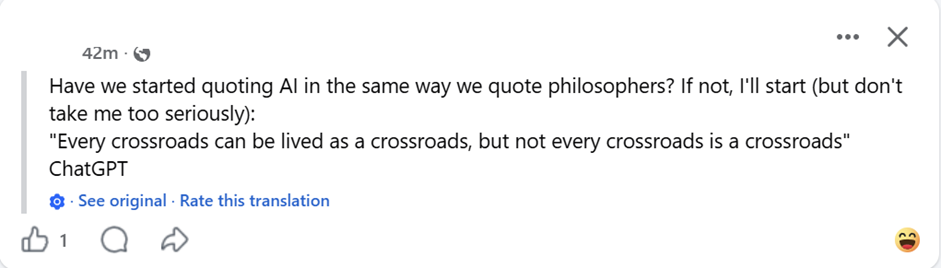
With a SQL certification, you have a document that clients value, so it’s highly likely they’d trust and pay you more. However, it doesn’t teleport you to Mars! You still have to choose who you work for, how to structure your work, and deal with the wonders (and blunders) of AI. Plus, there are certificates (and degrees) in AI alone.
So, we’ve established that, yes – you should still care about SQL certification in 2026. Employers still need humans; people with SQL expertise and the ability to use AI efficiently.
How to ensure you don’t get caught out by AI’s inaccuracies
ChatGPT says that its responses should be triple-checked before put to use, and it’s also imperative to consider that its responses are classified as ‘belonging to AI.’ Put simply, they’re copyrighted and can cause major issues if handled improperly. The bottom line is: don’t blindly trust everything from an AI chatbot. Double or triple-check its output. As a seasoned engineer, you must do your own research.
AI responses may be inaccurate (hallucinations)
Even when a response looks confident and well-structured, they may contain subtle errors, outdated info, or even fabricated details – such as APIs, functions, citations or behaviors that sound plausible but don’t actually exist.
Review your code!
Always review code for security implications. Humans can remind you that SQL is home to the most dangerous security flaw targeting applications. I just did – AI might. It might not.
Verbosity may sometimes prevail over clarity…
…especially when using AI. Don’t trust all AI models to provide you with information that goes straight to the point and always verify everything you’re about to employ in production.
The copyright consequences of AI
Ever considered writing a book? If you did, you’re most likely aware of the fact that you must own all of the copyright to everything produced in the book. Consider that AI’s responses are classified as ‘belonging to AI.’ Put simply, they’re copyrighted and can cause major issues if handled improperly.
AI chatbot filters can be bypassed
That’s not to say that they should be bypassed, but it can happen pretty easily. The result? AI chatbots can provide responses to a wide variety of things, including questionable topics or topics that are way beyond what you’d usually see. I’m not here to teach you how to bypass filters provided by ChatGPT or other AI-based sources, but you’d be surprised to learn how easy it is.
Bear in mind, the same is applicable to SQL too. Whack some SQL into your application without double-checking and you’ll be shocked at how fast someone will find a loophole around it. Such mishaps are one of the primary reasons why developers still have jobs! As you create your own path, you’ll encounter situations involving those again and again.
On the other hand, once you’re SQL certified, these situations are no longer always unexpected surprises – they’re recognizable patterns with known solutions.
How to become SQL certified/obtain a SQL certification in 2026
To become SQL certified in 2026, you’ll first need to decide which certification ecosystem fits your goals:
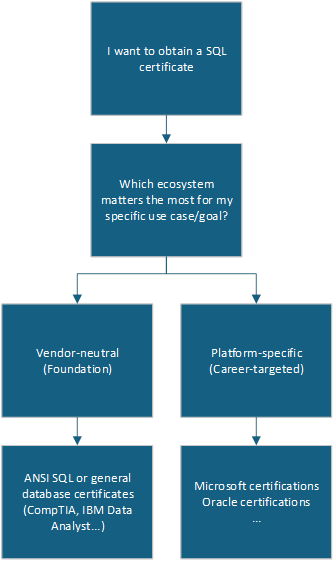
You then simply need to refresh yourself on the fundamentals of SQL. These include the functionality of CRUD queries, indexing, JOIN operations, subqueries and CTEs, and more.
The second step is practice. Yes, you can start with tutorials, blogs, books, or the official documentation, but you’ll quickly realize that the best way to gain experience is to install and work with a real application behind a database of your choice. In other words, to get ready, complete real tasks!
Create schemas, import datasets, create complex queries, slap on an index or two, drop a couple of partitions to see how data disappears, then pick a specific certification exam and start following the course for preparation.
When it comes to the courses themselves, choose a path that’s aligned with your exam, then focus on both the exam topics and the practice part. Do that in conjunction with completing practical projects, then complete a mock exam task aiming for at least a 90% completion rate. After that, you should be good to go!
What to do after becoming SQL certified
You’ve just scored 90% on a test, successfully completed an exam, and have received your SQL certification. Great! You’re now on your way to a potential salary increase, a better career path, higher-paying clients, etc. However, there are still a couple of key things to keep in mind:
Don’t just consume – you should be building, too!
We’re developers, which means we’re developing – building – tools that may or may not be scalable. They may become the best tools in the world, or they might fail and teach us a lesson or two. Either way, we’re building something for the end user. Certifications are just one path towards doing that more effectively.
Don’t just focus on designing SQL queries
Remember that applications and systems are powered by databases – and databases can fail! Connections can drop, disks can fill (see example error message below), clients and users can behave unpredictably, and so on. That’s why resilience and recovery will always matter as much as the accuracy of your syntax.#1021 - Disk full (/tmp/#sql_1a27_22.MAI); waiting for someone to free some space... (errno: 28 “No space left on device“)
Understand that the fundamentals often outlast tooling
As you move around in your career, you’ll learn that programming languages, frameworks, platforms, and just about everything else related to databases are all subject to constant change. Meanwhile, the core concepts of SQL – like data structures and algorithms – stay in stasis.
Learn to embrace trade-offs
Every engineering decision will have a downside. You’ll experience this when learning about SQL queries and, for example, the impacts of indexing and partitioning on UPDATE, DELETE, and INSERT queries. And, in many cases, the trade-offs may even outweigh the benefits. That’s why you need to know the ‘what’, ‘why’, and ‘when’ of what you’re doing. If you’re unsure, turn to AI, formulate your question in such a way that goes straight to the point, and see what it has to say.
Know what you’re looking for (and what to ask for)
Many developers would agree that bad project managers can be a nightmare, regardless of if they’re doing DBA work or not. That’s a reality because of concepts such as “scope creep”, and these aren’t exclusive to just software. Many clients will change their requirements once work has already started, so adaptability is key. You need to learn to adjust, and be able to put your foot down to get a project across the finish line.
This also teaches you to only work on projects that have a defined ‘finishing point’, with a measured outcome and clear results. In turn, SQL certification will help you understand the results quicker and more efficiently.
Summary: why you should become SQL certified in 2026
As I’ve mentioned before, SQL certification isn’t a golden ticket, but it’s still very advantageous in 2026. It’ll equip you with the knowledge necessary to make adequate decisions in the database world. It’ll make other people (your clients & co.) happier because you’ll actually know what you’re doing with their database. And, it will make your world brighter! You’ll have more confidence in your own abilities, more work opportunities, and you’ll likely be paid more.
Simple Talk is brought to you by Redgate Software
FAQs: How to become SQL certified in the age of AI
1. Is SQL certification still relevant in 2026?
Yes, SQL certification remains valuable in 2026 as SQL is still the standard for managing relational databases across industries.
2. Does SQL certification help with job opportunities?
Certified professionals often have better job prospects, as employers value proven skills in data handling and database management.
3. Can SQL certification increase salary?
While not guaranteed, SQL certification can lead to higher earning potential by improving credibility and opening doors to higher-paying roles.
4. How does SQL certification help in the age of AI?
It helps you understand and validate AI-generated outputs, ensuring accuracy, security, and better decision-making.
5. What are the main benefits of getting SQL certified?
Key benefits include structured learning, increased confidence, professional recognition, and expanded career opportunities.
6. Do employers prefer certification over degrees?
Not always, but certifications can give candidates a competitive edge, especially when practical skills are required.
7. How long does it take to become SQL certified?
It depends on your experience, but most learners can prepare within a few weeks to a few months with consistent practice.
8. What should I learn before taking an SQL certification exam?
Focus on CRUD operations, JOINs, indexing, subqueries, and real-world database practice.
9. Is SQL becoming obsolete due to AI tools?
No, SQL remains essential as AI tools still rely on structured data and databases powered by SQL.
10. What should I do after getting SQL certified?
Apply your knowledge through real projects, continue learning, and build practical experience alongside your certification.
This document contains proprietary information and is protected by copyright law.
Copyright © 2026 Red Gate Software Limited. All rights reserved



Load comments