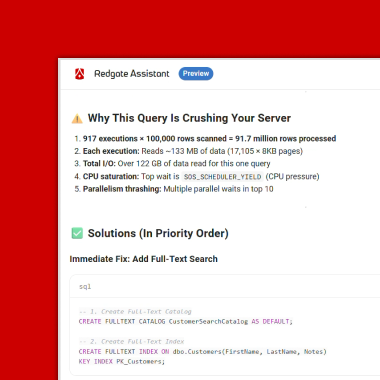
Redgate Monitor v12.0 has added a new Query Text Search feature to allow users to search the text of the most expensive queries that executed on a SQL Server instance over a period. Here's what it does, and how it works.Read more
One of your SQL Server instance shows a major dip in performance or throughput, affecting all the user databases. You notice that the slow interludes coincide, as if orchestrated. On investigation, it appears that several transactions running over that period were using a lot of space in tempdb. However, which…Read more
Phil Factor explains how Redgate Monitor helps focus performance tuning efforts on the tables and queries where 'rogue indexes' might be a significant problem, and then how to identify both 'missing' indexes that might be beneficial to the overall workload, and those that are unused or duplicated, and so are…Read more
In this article, you'll learn how to detect and remove a common cause of SQL Server query performance problems: reliance on implicit datatype conversions. We'll use a combination of plan cache queries, extended events, and Redgate Monitor.Read more
Phil Factor sets out with the modest aim of giving you enough of an introduction to waits to better understand the wait information you get from a SQL Server monitoring tool like Redgate Monitor, and the rather overwhelming amount of information available in the underlying DMVs and Extended Events.Read more
Jamie Wallis explains how Redgate Monitor can both reveal quickly who ran a deployment, and when, and automate the incident-response workflow to ensure it's dealt with swiftly. By extending such workflows to development and test servers, as well as production, the feedback cycle starts earlier, and you can stop problems…Read more
Phil Factor on the fill factor, pages splits and index fragmentation, and how Redgate Monitor can help you decide if a custom fill factor for certain indexes might help alleviate performance issues.Read more
When the tempdb database is heavily used, processes in any database on the instance will be forced to wait, due to contention as the SQL Server engine tries to manage allocation pages in tempdb. Phil Factor shows how to monitor for signs of trouble.Read more
Phil Factor creates a simple custom metric to track the number of sessions that have recently done a read or write on a database. Having established a baseline for the metric, you'll be able to spot, and investigate the cause of, any wild deviations from normal behavior.Read more