Phil Factor shows how to monitor for the errors indicative of a possible SQL Injection attack on one of your SQL Server databases, using a Redgate Monitor custom metric that uses diagnostic data from Extended Events.Read more
Grant Fritchey explains how a modern monitoring tool must adapt, as our SQL Server databases grow in number and size, and migrate onto new cloud-based, containerized or virtual machine-based SQL Servers.Read more
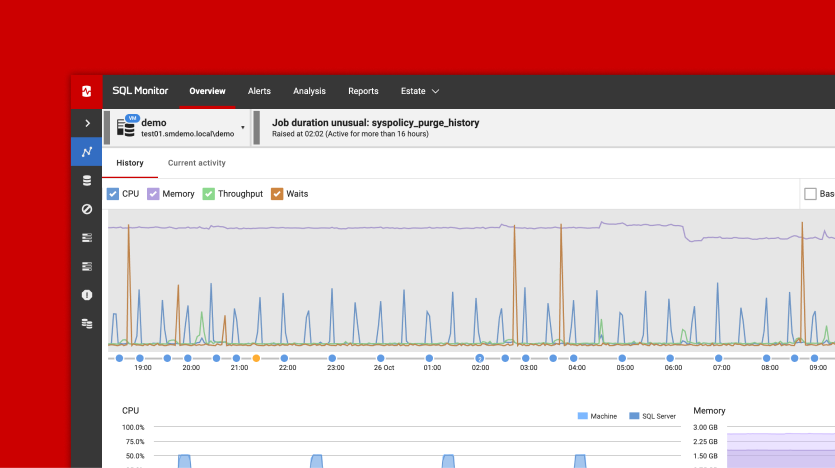
Redgate Monitor not only collects all the disk and database growth tracking data you need, automatically, but also analyses trends in this data to predict accurately when either a disk volume will run out of free space, or a database file will need to grow.Read more
Tony Davis describes the features and capabilities of Redgate Monitor that allow it to scale smoothly to monitor a growing estate of servers and databases, while still providing a single, simple dashboard that gives the team all of the essential SQL Server metrics and alerts, establishes baselines, and detects trends…Read more
Redgate Monitor tells us immediately when significant blocking occurs, and where, during busy periods, and provides the full blocking chain, in an easy-to-digest graphical format, so we can diagnose and resolve the blocking quickly.Read more
If your SQL Server estate is large, or installed across different, isolated networks, or both, then you need a distributed monitoring solution. It is very easy to set up multiple base monitors in Redgate Monitor, and then to manage the monitoring, alerting and troubleshooting for your entire SQL Server estate,…Read more
Overuse of ad-hoc queries by applications is a common source of SQL Server performance problems. The symptoms include high CPU and memory pressure. Phil Factor offers a simple custom metric to monitor the percentage of ad-hoc queries being executed on a database, and shows how Redgate Monitor can detect when…Read more
Use of the read committed snapshot isolation level is often an effective way to alleviate blocking problems in SQL Server, without needing to rewrite the application. However, it can sometimes lead to tempdb contention. This article offers a small-scale solution (not suitable for use on large tables) to detect cases…Read more
This article explains what SQL Server deadlocks are, why they occur, why they require immediate investigation, and the diagnostic data required to troubleshoot them. It then demonstrates an "Update Order" deadlock condition and shows how to find the cause quickly, in Redgate Monitor, using the Extended Events deadlock graph provided…Read more