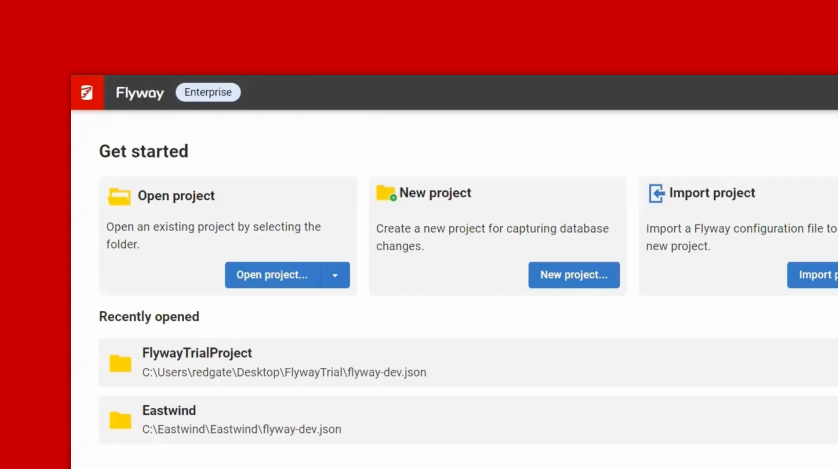
This article discusses Flyway's transition from CONF to TOML configuration files. It highlights the advantages of TOML, such as improved readability, flexibility in managing complex database configurations, and support for specifying multiple database environments. It also discusses a few of the differences to be aware of when switching existing Flyway…Read more
The Validate command aims to ensure that Flyway can reliably reproduce an existing version of a database from the source migration scripts by warning you if files are retrospectively added, removed or altered that would prevent it from doing so. Validation errors are Flyway's warning that "the source for this…Read more
The Clean command resets a database to its initial state, before any Flyway migrations were applied. In other words, it empties the database. This can be useful for any development task that requires that you recreate the database structure, or for tearing down a test harness. It also allows you…Read more
If you need the current version of your Flyway database, and a history of the changes that were applied to build that version, then the info command is the place to go. It allows you to review applied and pending migrations, track migration status, and troubleshoot any issues that may…Read more
Flyway has several ways of allowing you to make mistakes, or even experiment wildly, and then tidy up afterwards easily. In this article, I'll describe a few ways to persuade Flyway that you know what you're doing and that it needn't ignore a migration file.Read more
Flyway can scale easily to enterprise-scale database systems, even if they involve a mix of relational database systems, are cloud-based, containerized or involve complex authentication. This article demonstrates how we can use Flyway Teams to do a single-batch, multi-database migration, comprising SQL Server, Oracle Cloud, PostgreSQL, MySQL and SQLite databases.Read more
We can use callbacks in Flyway to plug into any part of the Flyway lifecycle and run various database tasks before or after a particular event takes place. In this article I've tried to assemble a 'best practice' guide for writing callbacks to ensure that the scripts always behave predictably,…Read more
This article explains the various ways of using placeholders to pass information and settings to any Flyway script, to gain bit of extra flexibility in a migration run., providing examples of conditional execution, running SQL expressions using environment variables and even one of using placeholders in a callback to send…Read more
If you can convert a SQL file to HTML, then you can inspect your Flyway migration files in a browser. This is especially useful if your SQL is color-coded with the same conventions as it was in your IDE. It is even better still if your browser can allow you…Read more
This article demonstrates a PowerShell automation technique that will allow you to run any Flyway build or migration task on any number of projects and databases, hosted on a range of RDBMSs. It handles all connection and authentication details securely, makes it easier to automate database testing and can send…Read more