


Why even the best teams struggle with cloud migrations
You’re in charge and you’ve decided it’s time to move to the cloud. Or, you’re a data professional and have been strictly told, it’s time to move to the cloud. It’s all good. You’ve got a great team. They’ve worked together for a number of years. You have testing and automation in place. You’re confident of your existing processes because they’ve been tested by time and adversity.
Moving to the cloud is going to be mere snap of the fingers.
However – and no disrespect to you or your team – cloud migrations do, in fact, often come with a few surprises. It’s not that your team isn’t capable of making the leap to the cloud. I’m positive they are. It’s not that your current processes and automation won’t help you along the way because, without a doubt, they will.
In reality, the increase in risk in moving to the cloud is all about a lack of knowledge – and it’s that which leads to heightened risk.
The ‘unknown unknowns’ of a cloud migration
Without getting into a history debate, or worse yet, a political one, this quote from Donald Rumsfeld should be plastered to every technologist’s wall:
“There are known knowns; there are things we know we know. We also know there are known unknowns; that is to say, we know there are some things we do not know. But there are also unknown unknowns—the ones we don’t know we don’t know.“
A migration to the cloud certainly carries some known unknowns. Just as an example, you’re probably fully aware that if you were migrating to a Platform as a Service (PaaS) offering such as AWS Aurora, backups are managed for you.
However, one of the first known unknowns we can quickly identify is, what does that mean for recovery of your databases in an emergency? How long will it take to restore your database in Aurora? To what extent is a point-in-time recovery (PITR) possible? These are known unknowns.
Your team is competent. Without a doubt, they’re going to be aware of these unknown values and will plan accordingly. They know that they don’t know how to do a restore within AWS. So, they’ll go find out. They’ll make sure they’ve tested it and trained. Because they’re a competent team already, they’re going to make those kinds of plans. The problem lies elsewhere.
What are the cloud migration challenges in 2026?
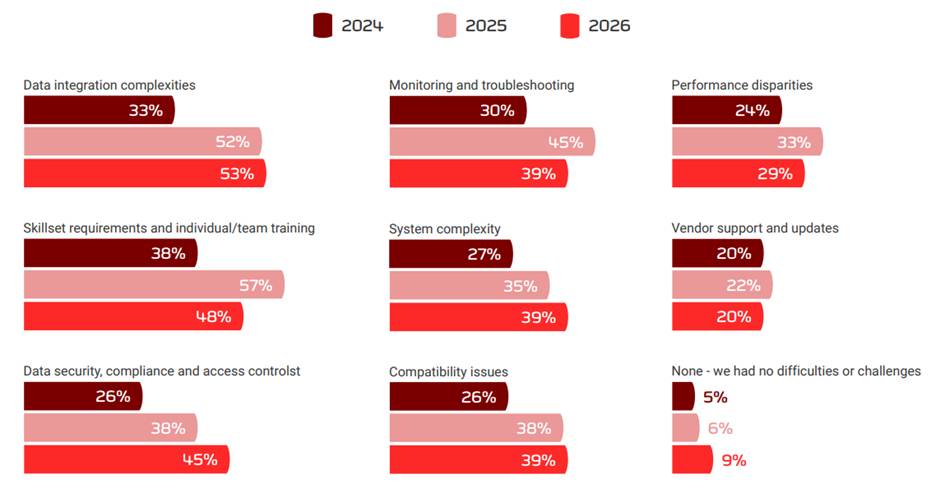
The chart above is from Redgate’s State of the Database Landscape 2026 report. Interestingly, 9% of respondents said they had no difficulty at all in moving to the cloud. However, that means that 91% did.
A healthy percentage of the issues they ran into were complexities caused by data integration (53%), system complexity (39%), and skillset requirements (48%). In short, just shy of half of the organizations out there that ran into problems during their migration to the cloud had issues because of training and knowledge – or a lack thereof.
That’s what I mean when I say ‘unknown unknowns’.
It’s not just about the technology, either. Adding the cloud to your systems also introduces the need to manage security around your data differently. While there are a number of ways to integrate your existing security with the cloud in a hybrid environment, once more, ‘unknown unknowns’ are introduced. Can your existing security infrastructure, however successful it may be locally, be readily integrated with a cloud-based security model?
The hybrid situation dilemma
What’s more, even if you plan to 100% fully move to the cloud, you’re going to be in a hybrid situation for some period of time. Some data will move quite readily to the cloud, and some will simply take longer.
However, most organizations end up staying in a hybrid situation on a more permanent basis – either partly in the cloud or partly locally managed. And, according to our findings, it’s exactly this situation that leads to the most problems:
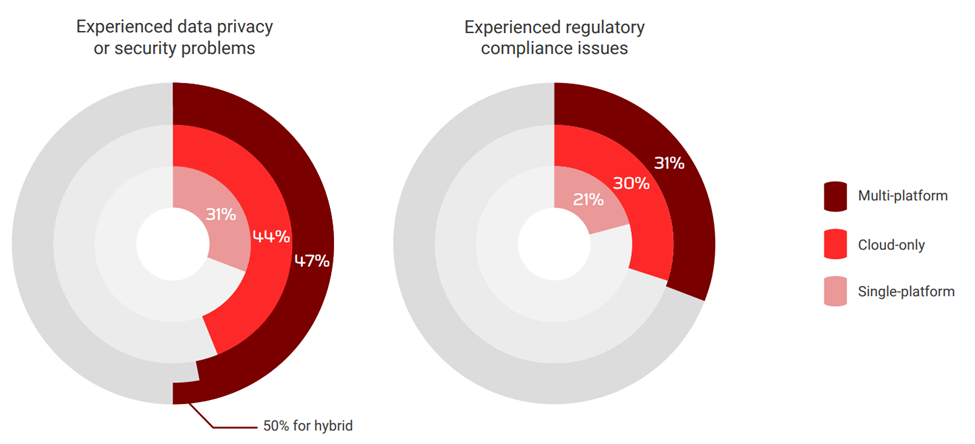
50% of those in a hybrid environment experienced data privacy or security issues. Again, this is because of the things we simply don’t know before we make the migration.
Data quality challenges
One more issue that’s very likely going to be a challenge, even for your talented team, is continuing to maintain data quality as you move to the cloud. You’re adding in a whole new technology stack to your existing processes. Sure, ultimately it’s going to deliver superior mechanisms for you to manage and maintain your data – otherwise why make the effort?
However, our survey data again shows where people are hitting problems with their data quality:
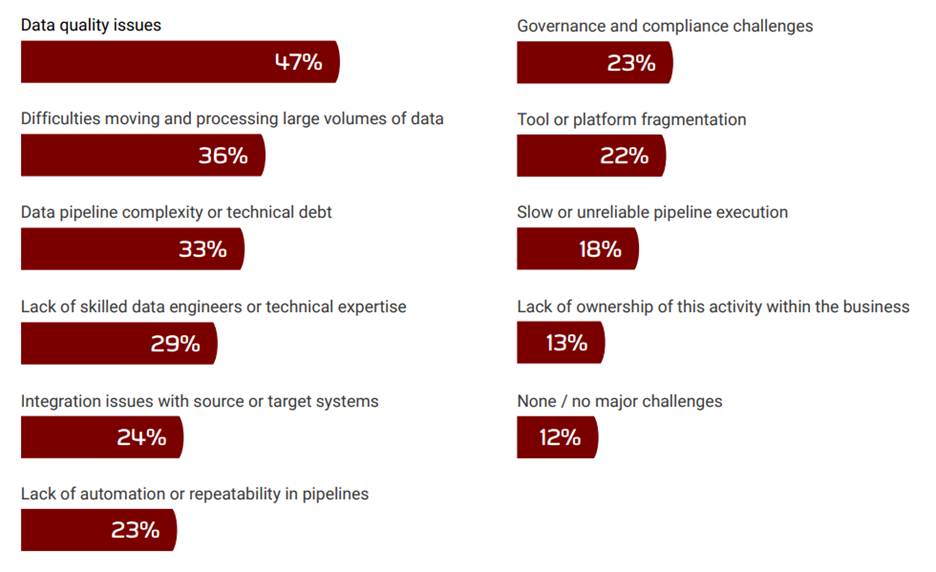
Happily, with an already successful team, you’re very unlikely to be in the 48% of respondents who said they simply had fundamental data quality issues. You’re also unlikely to hit difficulties moving large volumes of data, and you probably won’t suffer from lack of automation or even a lack of ownership, either. Good teams already have these types of problems under control.
So, any data quality challenges you do have are likely to be much smaller, which is great news. But – the challenges are still there, no matter how small – for example, 29% of respondents cited a lack of necessary technical expertise.
Put simply: the cloud is different. Your team, however good they are now, will need to be enhanced. 24% of respondents have already experienced integration issues – and you’re introducing an all new integration point.
Finally, 22% encountered issues because of tool or platform fragmentation…and you’re likely to be fragmented for a period of time.
Your path forward (how best to tackle cloud migration challenges in 2026)
The good news is, even with ‘unknown unknowns’, a high-functioning team with well-defined processes and established automation mechanisms are likely to have the versatility to deal with these unknowns. You’re probably already thinking this through, but allow me to add a few points to help things along:
- Acknowledge up front that there are aspects of the cloud platform you’re moving to that you simply don’t know about.
- Plan to add additional, specialized, testing to your existing automation pipelines in order to catch issues early in the process.
- Create the time and space necessary for you team to develop the new knowledge and skills that the cloud platform is going to demand.
- Don’t assume that the data platform you’re moving to will behave 100% like the on-premises version that you’re used to.
- Make the assumption up front that, at least for some significant period of time, you’ll be in a hybrid environment (part way on the cloud, and part way off). Or, assume up front that you will always be in a hybrid environment. This is, most of all, likely to make your move the cloud more successful and less painful.
In summary
You’re in a privileged position to have (or be in) a highly functional team. Just don’t let how good you are blind you to the fact that there are still things you don’t know.
Further, there are things you’re not even aware that you don’t know – the ‘unknown unknowns.’ Simply taking that into account as you make your plans for your migration to the cloud will help to increase your versatility, making for a more successful migration.
Enjoy this article? You may also be interested in:
Over on Redgate's technical journal and blog, Simple Talk, Redgate Advocate Pat Wright shares his advice from the many cloud migrations he’s been involved with – covering the good, the bad, and the ugly – in his 7-part ‘DBA Stories’ series on how to move to the cloud.
This document contains proprietary information and is protected by copyright law.
Copyright © 2026 Red Gate Software Limited. All rights reserved
The Cloud Migration Divide
2026 State of the Database Landscape
Cloud adoption is accelerating, but database migrations aren’t keeping pace. Find out why in our latest report.
You may also like

Blog
Announcing the Flyway Docker provisioner, now in Preview in Flyway Enterprise

Blog
Without Governance, AI Is Just Faster Failure
Blog
Loading comments...