



Although ‘Big Data’ (and more specifically, the analysis of it) offers several benefits, organizations often fail to derive the correct insights – the data that could help them make better business decisions.
So, in this article, I’ll reveal exactly how organizations can take full advantage of these large datasets to make those better business decisions and improve operational effectiveness.
Before we begin, though, we must first understand the actual problem with big data.
What’s the problem with big data?
Data has quickly become one of the most valuable assets to today’s businesses. Unfortunately, because of the complexity of working with large volumes of data, many organizations still lack a well-defined plan or strategy for harnessing and managing their data.
This is despite many businesses investing billions over the last decade or so in building big data platforms, enabling them to produce significant amounts of data. They’ve acheived that part, but simply haven’t put enough thought into the strategy behind it – so they’re not gaining the valuable insights from the data that would be helping them create meaningful business outcomes.
Organizations should be taking full advantage of big data – using it to generate business value by aligning their big data efforts with specific business objectives.
What is big data?
Before we start looking at the correct ways organizations should be using big data, it’s first important to fully understand what big data actually is.
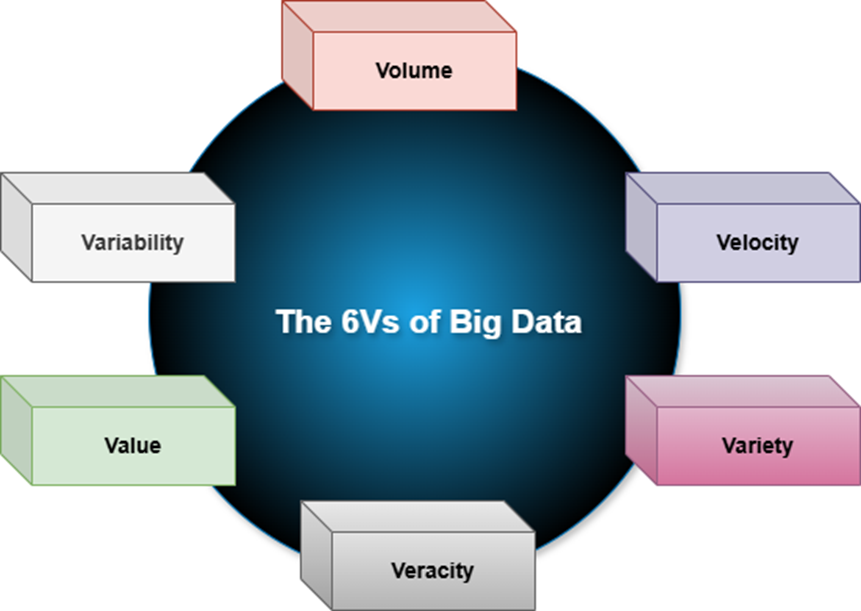
Big data refers to a collection of structured or unstructured data that traditional information systems cannot handle. It’s often summarized by the ‘6 V’s of Big Data’, which comprises of:
- Volume
The massive volume of data generated or collected every second from a variety of sources, with an increasingly large total worldwide. - Velocity
The speed of generating, collecting, and processing data. Most big data is generated continuously, at extremely high rates. - Variety
Used to describe different types of data – such as structured, semi-structured, and unstructured. - Veracity
This denotes the quality and trustworthiness of your data. Big data is often of poor quality, incomplete, or inconsistent – all of which are of no use to organizations. - Value
This refers to the usefulness and/or benefit you receive from an analysis of your data. The value and importance of the data increases as you start resolving issues, enhancing decision-making, and developing new insights. - Variability
This refers to the extent to which your data changes over time in terms of flow, format, and meaning. Note that the more variability or inconsistency in your data, the harder it is to interpret and analyze it.
How to improve trust in data
The 6 key benefits of big data
Big data offers some key benefits, including:
The enablement of smarter decision-making
The insights generated from real-time analysis of big data can help organizations make better, faster, evidence-based decisions.
Accelerated development cycles
Technology has increased the importance of shortening product development cycles. To help with this, organizations can use real-time big data and feedback to ensure products are built to meet the expectations of their customers.
Better market research
Real-time analysis of vast amounts of data allows businesses to understand demand, interests, and behavior patterns far more effectively than traditional data collection methods.
More efficient risk management
Businesses can use the big data collected from multiple sources and perform analytics on those datasets to forecast – and prepare for – potential issues in the future.
Increased productivity
Businesses can utilize large amounts of information from multiple sources to review their processes, resources, and workflows. They can spot which areas of the business are performing well, which areas are struggling, and determine what action they may need to take.
Enhanced operational efficiency
Businesses can use large amounts of information from various sources to identify potential bottlenecks and determine better ways to allocate, or use, their resources to resolve these issues. They can also use big data for proactive monitoring of their systems.
5 reasons big data projects fail
This also refers to big data not being fully utlilized by organizations (or organizations not getting the full benefits of using big data.)
Misaligned strategy
While technology is an important enabler of success for big data initiatives within an organization, one of the prime reasons they fail is simply due to misaligned strategy. For example, organizations often start with a technology platform and then try to fit their strategy around it.
Instead, they should define their particular business problem, and then select the best technology platform to help tackle that problem.
Poor data quality
Poor data quality is another concern, as it may further worsen the disconnect between the business and the insights derived from the data. This is usually due to the lack of an established, adhered-to data engineering standard.
Ultimately, data quality should be a continuous discipline. Inaccurate data can be worse than having no data at all!
Treating data as an IT issue
Organizations often make the mistake of treating data as an IT issue, which it is not. When business stakeholders don’t participate in developing a strategic approach to use the data, how do the insights produced from the data match up with the business objectives? The answer is: they don’t.
Complexity
Big data initiatives can fail simply because of complexity. Teams often over-engineer real-time streaming capabilities when they could simply use batch processing that delivers incremental business value.
Lack of trained personnel
To be successful in your big data initiative, you need the right people, in the right place, at the right time. Your organization must have data experts with domain expertise. However, finding the right talent to meet your specific big data needs can, unfortunately, be quite a challenge in itself.
How to get the most out of big data: 5 key strategies
Organizations must know how best to collect, store, and analyze their big data to realize the full value of it. How do they go about doing so? In this section, we’ll look at how to successfully implement big data in an organization and leverage its benefits to drive business value.
Foster collaboration to drive innovation
Creating a culture of collaboration is imperative. Your organization should encourage collaboration to drive innovation, foster exchange of ideas, and facilitate development and learning opportunities among employees.
Focus on the quality of the data
Data quality is extremely important in any big data initiative. The data must be accurate, reliable and up-to-date to ensure the best insights are extracted from it. Hence, you should have proper data management processes in place to ensure you capture, maintain, and monitor the accuracy, reliability, and timeliness of your data.
Select the right method to access big data
First off, an organization should determine the right strategy for accessing big data. Since each organization will have its own unique requirements, use cases, and infrastructure, an organization must decide which approach (or combination of approaches) should be used.
Aggregating data
There are many data sources available to you, and they vary widely in type. It is important to successfully aggregate data by combining and formatting diverse sets into a cohesive whole.
It is actually a challenge for an organization to create a single unified dataset from a variety of fragmented or differently formatted datasets. This has emerged as the most important factor in determining whether your organization will succeed in leveraging the benefits of big data in today’s rapidly changing digital landscape.
Cost management
Without appropriate governance, big data platforms can get very expensive very quickly. Over time, storage, compute, and data transfer costs can increase – often with no warning or notification.
How to manage costs – 7 key strategies
The latter point is a big one. Here are 7 key strategies you can implement to help manage costs:
- Implement a tiered storage strategy that can help you to categorize your cold, warm, and hot data.
- Take advantage of cost-effective ways to help you to manage and organize data using indexing and partitioning methods.
- Establish a suitable approach to automate scaling (i.e., increase/decrease storage capacity according to usage) and scheduling workloads.
- Repeat the cleaning of old or duplicate datasets regularly. This will help to reduce the costs associated with maintaining large amounts of redundant or outdated datasets.
- Utilize auto scaling and workload scheduling processes.
- Perform regular cleanup of your unused datasets.
Finally, keep in mind that cost management is not (and shouldn’t be) a ‘one and done’ – it’s a continuous process.
What does the future hold for big data?
New and emerging technologies such as edge computing, blockchain, and quantum computing will change how businesses handle and process data.
Here are the key trends to watch out for:
Predictive analytics
Predictive analytics is the process of using past data to gauge the future. It’s a capability often used by retailers, financials, and the healthcare industry to improve their operations while anticipating trends and consumer preferences.
AI/ML (machine learning) integration
Using AI/ML enables the automation complex decision points, opening up new methodologies for analyzing and gaining insights from previously unavailable data.
Cloud computing
In the cloud, businesses can securely host and manage large quantities of data without significant investment. They’re also better positioned to respond to changing market conditions.
Big data: summary and key takeaways
- In this technology-driven world, the organizations that will eventually emerge as winners are those with the most clearly defined value chains – from raw data to the resulting business outcome.
- Big data does not fail because of the technology; it fails because there is no meaningful data fed to it. You should ensure that the data you have is correct, accurate, complete, and up-to-date before analyzing it.
- Organizations that are ahead of others are focusing less on the volume of data they collect and more on the quality and reliability of data.
- And the change is subtle and significant: from data collection as an automatic organizational practice, to using data to drive business value.
- Organizations that do not take a disciplined approach to strategic governance and management of their big data may be subject to uncontrolled growth of storage, compute, and transfer-associated costs.
- A thorough big data analytics plan is the first step to realizing the potential of big data. The strategic plan should define your critical objectives, the trade-offs between them, and set priorities.
Simple Talk is brought to you by Redgate Software
This document contains proprietary information and is protected by copyright law.
Copyright © 2026 Red Gate Software Limited. All rights reserved








Load comments