


Redgate Monitor Product Updates – May 2026
Redgate Monitor ships new features every month and the past few months have brought some exciting new additions to empower your workflows. Spanning AI-powered tooling, cloud deployment, cross-database platform support and enterprise security, these updates reflect some of the biggest areas shaping how database teams work today.
Whether you're managing compliance requirements, trying to get on top of alert management or looking to get a better grip on cloud costs, there's something here for you.
Stay ahead of potential issues with smarter alerting and AI-powered diagnosis
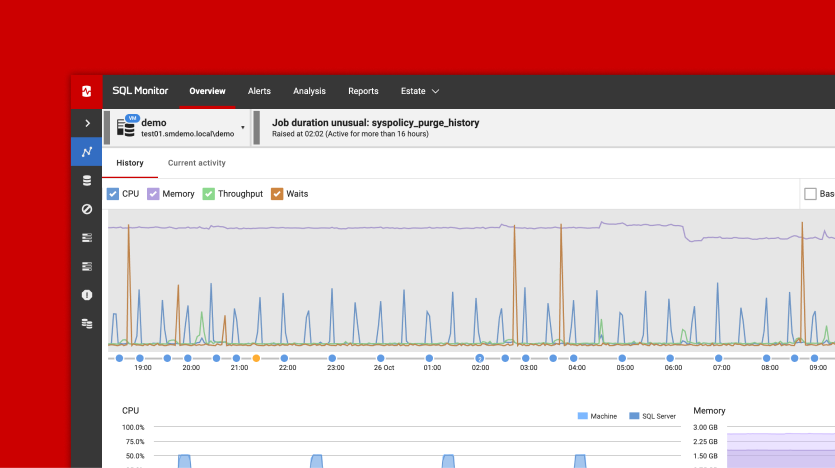
Dynamic Alert Thresholds (v14.00) and AI Alert Analysis (v14.15) work together to shorten the time a DBA spends on alerts. Dynamic Alert Thresholds uses machine learning to set thresholds against each server's own normal behaviour, so fewer false-positive alerts fire in the first place. The ML runs locally on your Base Monitor, so no data leaves your environment.
When a long-running, deadlock or blocking query alert does fire, AI Alert Analysis returns a plain-language summary of the likely cause alongside it, pulling together the data and context a DBA would otherwise gather by hand, with the option to dive deeper into the execution plan.
The result: fewer alerts to wade through, and a head start on the ones that matter.

Redgate Monitor is now available as a fully managed SaaS
If your organization has a cloud-first policy or simply wants to direct engineering time toward strategic work rather than tooling maintenance, Monitor is now available as a fully managed, cloud-hosted service. Install a lightweight agent in place of any Base Monitors and Redgate handles everything else: hosting, security and software updates.
Learn more about Redgate Monitor SaaS.
Take control of virtual machine (VM) spend with estate-wide visibility
Redgate Monitor now brings VM cost data from Azure (v14.15) and AWS (v14.17) directly into the platform, giving you a consolidated view of your entire estate. See allocated versus actual usage across vCPUs, memory and storage for every virtual machine, with costs pulled directly from your cloud provider and the ability to compare against the previous period. The gap between what you have provisioned and what you are actually using becomes immediately visible, giving teams the data they need to make confident right-sizing decisions and get cloud spend under control.

Expanding cross-database support
Recent releases have brought new capabilities across Postgres and Oracle in Monitor.
For Postgres, Query Plan Compare (v14.14) shows exactly when the PostgreSQL optimizer switched execution plans for a query and why, so sudden performance regressions are quicker to diagnose, read our walkthrough to learn more. Wait Stats (v14.10) surface wait events to identify the root cause of slowdowns without manual investigation and Tracked Queries (v14.4) lets you persistently monitor specific queries and track their performance over time.
Oracle databases now join SQL Server and Postgres with full custom metrics support (v14.14), letting you track the specific values, counters or query results your Oracle environment requires in the same dashboards and alerting framework used across the rest of your estate.
Database audit compliance made simple*
Redgate Monitor Enterprise now uses SQL Audit (v14.15) to track permission changes (v14.15) across your monitored servers in granular detail, logging every change with the exact user responsible and a timestamp. Results are presented in an easily filterable, exportable report, so your team has everything it needs ready for an audit, without any manual log digging.
*Available on Redgate Monitor Enterprise only.

We ship updates to Redgate Monitor every week, with new capabilities landing across the full product. To see everything that's new and get a view of what's coming next, visit our roadmap webpage.
Have a feature in mind? Tell us what you'd like to see built.
Tools in this post
Redgate Monitor
Real-time multi-platform performance monitoring, with alerts and diagnostics
You may also like

Blog
In 2026, engineering teams are quietly accepting more risk. Here’s why

Blog
Customer-led, independently proven: Redgate Monitor's G2 Spring 2026 awards

Blog
Loading comments...