



Data is one of the most valuable assets an organisation can hold — but only if it’s managed, governed, and used strategically. That’s where data leadership comes in.
Data leadership is the practice of guiding an organization to extract real business value from its data, through smart collection, governance, and a culture of data literacy. It sits at the intersection of business strategy, technology, ethics, and people.
In 2026, the stakes are higher than ever. With AI adoption accelerating, regulatory pressures tightening, and cyber threats growing, organisations need data leaders who can build trust, drive decisions, and future-proof their data operations. This guide covers everything you need to know.
The importance of data for organizations in 2026 and beyond
Organizations use data and analytics to inform their decision-making instead of relying solely on instinct and/or life experience. Solid data will always be more reliable than just anecdotal evidence.
It works as so: data is collected and then analyzed, sometimes with the help of machine learning algoritihms and other analytics tools. The results of the analysis are then often what informs decision making and next steps within an organization.
This is not just a one-time process, and the organizations that get the most out of data are the ones that continue to collect, analyze, and learn from data, iteratively and continuously.
What is data leadership – and why is it important?
Data leadership refers to a set of principles that guide an organization to derive business value from using data, through appropriate collection, management, and governance of the data. There are three core components of data leadership:
- The strategic direction which focuses on defining what the vision for data as an asset is;
- The operational oversight which focuses on maintaining quality, security, and availability of the data;
- The cultural influence which influences data literacy and the level of governance over the data.
Data leadership is critical for the success, innovation, and sustainability of the business – encouraging enlightened decision-making based on strategic insights.
Data strategy leaders don’t simply enjoy the prized insights gleaned from analytics; they require them to inform and set the organization’s goals, create effective strategies, and optimize the allocation of resources.
5 key reasons why data leadership is so important in businesses today
The benefits of effective data leadership within an organization are numerous. Here are five of the most important:
- Data leaders manage the transformation of raw data into actionable insights that can create business value for the organization;
- They, in turn, help organizations make smarter, more informed decisions;
- They establish standards and accountability to ensure the data is always accurate, reliable, and consistent;
- A data leader manages risk and compliance to tackle the ever-tightening regulations around data privacy and AI;
- They’ll build a culture of data literacy across the organization.
By implementing efficient data leadership, a business can encourage innovation and agility, foster operational efficiency, and optimize business processes.
What are the key pillars of data leadership?
Data leadership connects business strategy, data governance, technology, people, and processes. In more detail:
- Business strategy provides the purpose and direction to the work you do with your data;
- Data governance encompasses the rules, accountability, and trust on data;
- Technology supplies the required infrastructure and capability to use your data;
- People are needed to provide skills, literacy, and culture for work with data;
- Processes turn intent into a repeatable, reliable practice while adhering to the defined policies and guidelines to work with the data.
Data leadership in 2026 and beyond
Data leadership is redefining itself. Where we once focused on governance, reporting, and infrastructure, the remit of data leadership now covers technology, ethics, and value to an organizational mission.
With the usage of distributed systems, AI-driven applications, and real-time data systems expected, leaders in data must build systems that are scalable, performant, ethical, transparent, and resilient.
You may also be interested in:
The social impact of AI and data privacy issues
The 6 key challenges of data leadership today
The six key challenges data leaders have to tackle in today’s world include:
- Taking action based on data that is aligned with key business outcomes;
- Breaking through cultural ‘resistance’ and improving data literacy across the organization;
- Building and maintaining customer trust in a data-driven world;
- Managing the complex demands of data compliance;
- Effectively using data to inform every business decision;
- Accountability not only for what you deliver, but also for the outcome.
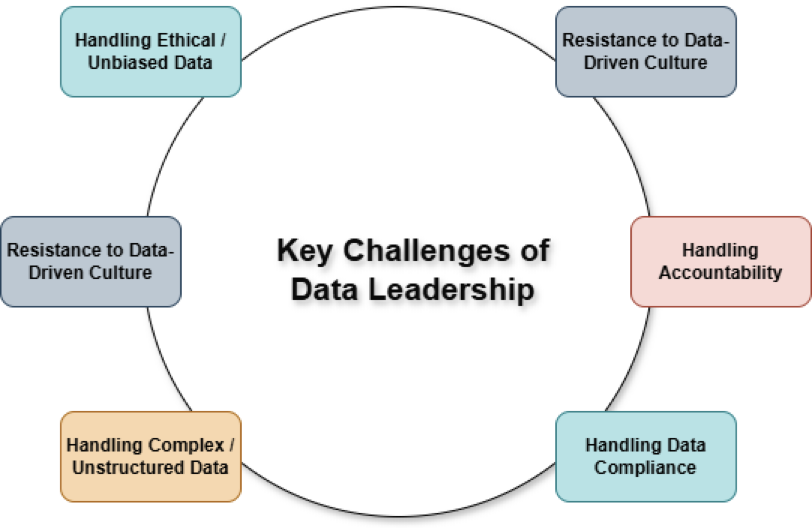
The six key challenges of data leadership
From control to enablement: data leadership then & now
Data leadership used to be all about governance, reporting, and infrastructure. More recently, though, the focus has shifted to the strategic discipline of technology, and maintaining high standards of both ethics and business value.
To better support business objectives and get value from their products and services, new and evolving data leaders need to:
- Align data strategy to business outcomes and product innovation;
- Create decentralized data ownership through domain-based architectures;
- Provide high-quality, observable, and reliable data in large amounts;
- Create governance of the ethical use of data, particularly within AI-based systems;
- Create an overall culture of data literacy for all employees.
Advancements in AI/ML algorithms have changed how organizations analyze data today and have facilitated faster, more accurate decision-making. In turn, this has created an opportunity for organizations to develop strong ethical principles as they implement data-driven leadership strategies.
The pillars of ‘future-ready’ data leadership: resilience, ethics, and culture
The three key pillars of ‘future-ready’ data leadership are resilience, ethics, and culture.
Resilience provides continuous, trustworthy data operations through robust architecture and processes.
Ethics provides the foundation for all decisions through proactive privacy, fairness, and responsible use of AI.
Culture provides an avenue to promote and support the use of data in everyday operations by creating an environment that fosters data literacy, safety, and collaboration.
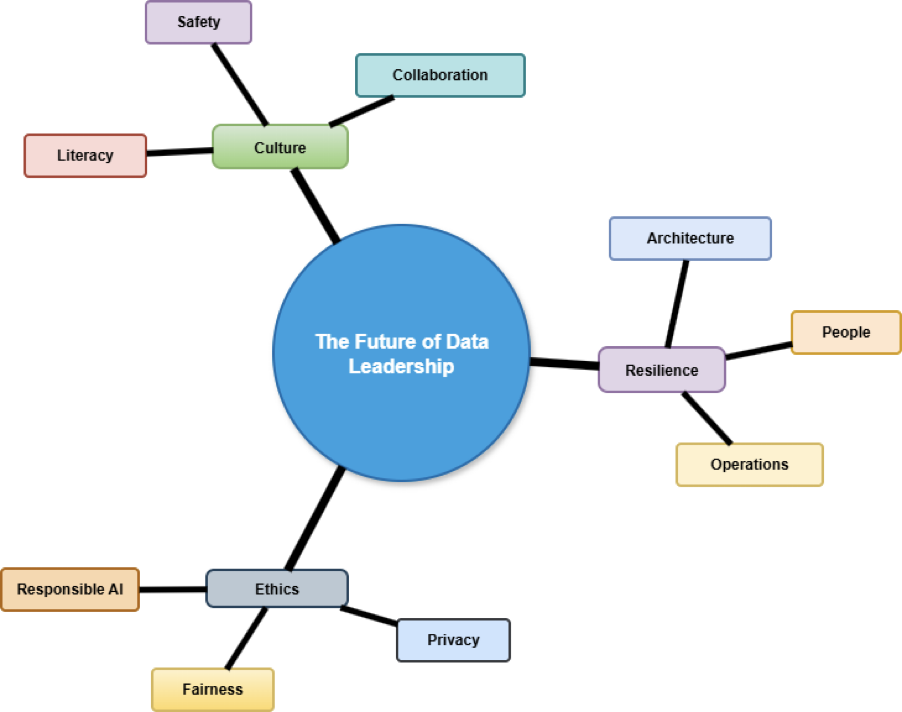
Organizations that focus on all three can develop and implement data-driven decisions that withstand change, support the organization’s core values and principles, and empower every team member to act with integrity.
The future of data leadership: what should data leaders be preparing for?
Here are some of the key trends to watch out for in 2026 and beyond:
The rise of AI/ML
We’ve already seen the rise of deep learning, where neural networks are used to automate key decisions and produce results. These deep learning models will become more accurate over time and give business leaders a better ‘gut feel’ for decision-making.
Additionally, AI-driven tools that can directly assist in data engineering, automate data quality monitoring, and serve as user-friendly data interfaces for human interactions, are changing the job itself – not threatening it. But a data leader’s remit still has to adjust in terms of team structure, prioritizing skills in demand, and organizing work in ways that mesh with what AI can do.
The growing need for ethical data governance
Organizations that collect data are already facing significant litigation over data privacy issues. Business leaders will have to focus more on transparent, ethical data governance that ensures data regulations are followed.
Data availability is more important than ever
Data is now more widely available than it has ever been and the amount of data is set to increase. Companies will invest in the tools and platforms that allow their technical people to access and interpret this data, leading to a more data-literate workforce.
Widening regulatory scope
Increased focus on data sovereignty and security
As organizations face increasing pressure from the surge in cybercrime and with more countries implementing privacy laws, leadership teams are focusing on developing sound data governance policies to ensure they know where their data is located and have a handle on it.
With the surge in cybercrime worldwide and the growing number of disparate global privacy laws, organizations must establish effective data governance processes to create visibility into where their data originates and resides.
Data & AI observability
Organizations cannot stay ahead of the competition by creating pipelines alone. Instead, today’s data leaders are now implementing observability frameworks to monitor the accuracy, drift, and quality of their AI models in real time. Organizations that invest in high-quality data and develop a well-curated, accessible data infrastructure will see a positive impact on their AI initiatives and gain a competitive advantage.
Protect your data. Demonstrate compliance.
What is data resiliency and why does it matter?
Data resiliency refers to the ability to store, safeguard, and manage data even during events such as outages or failures. A data resiliency strategy helps organizations develop plans to ensure they can maintain, protect, and restore their critical information during unexpected loss events, so application users always have immediate access to the information they need.
Data resiliency helps an organization preserve, protect, and recover critical data in the event of unexpected events. It ensures that all organizations can maintain their data even during temporary outages or failures. Effective data resiliency requires organizations to implement tools and technologies that automate the processes involved in monitoring, replicating, and restoring their critical information.
How is data resiliency acheived in 2026 and beyond?
To achieve data resiliency in 2026 and beyond, common best practices to follow today include:
- Perform regular backups of the data preferably at multiple storage locations;
- Maintain multiple copies of the same data to prevent data loss;
- Establish a proper data recovery plan that defines the disaster recovery strategy as well;
- Define data integrity strategy to ensure that the data is not corrupt or altered.
Top strategies for effective data leadership
A successful data leader should treat data as an asset that creates value for the business, rather than simply a collection of information and statistics. Here are the key strategies to implement for effective data leadership:
Align data initiatives with business objectives
In an organization, efficient data leaders are those who are able to align every data-related project with business goals to produce measurable outcomes for the organization. Effective leaders can take complex analytical information and translate it into tangible business value for the executive and other stakeholders, who will be readily able to comprehend the information and will support its use. Efficient data leaders need to engage proactively in alignment with business goals.
Foster a data-driven culture
In any organization, strong leadership fosters an environment in which business decisions bank on evidence instead of intuition. A data-driven culture fosters an environment where everyone has access to high quality, trustworthy data. This will require an ongoing commitment from the business leaders in an organization to demonstrate a strong focus on building and reinforcing data-driven thinking at all organizational levels, across all functions.
Facilitate higher governance and quality standards
If you’re to derive reliable insights from your data, the data must be secure and well-managed. Establishing accuracy, privacy, and compliance standards will guide you, provide you with an outline to work with, and enable you to maintain accountability for yourself and your organization.
Furthermore, governance processes provide you with the means to protect yourself from significant losses, establish trust with stakeholders, and comply with the legislative and ethical responsibilities that may change at any given moment.
Build talent
The success of any data initiative is driven by the analytical abilities of the business leaders who use the data within the organization. The best data leaders are those who include data literacy as part of their data initiatives. That doesn’t mean just training programs, but the development of targeted capabilities that enable business leaders to make better, more informed decisions.
Foster collaboration
Effective data leaders should build talent for an organization by recruiting qualified individuals and mentoring them through the training and development process. Additionally, they will create collaborative opportunities and foster talent development by mentoring data analysts, building cross-functional partnerships, and providing the vision for a future with resilient teams that can thrive in rapidly changing technological environments.
Key takeaways: data leadership in 2026 and beyond
Technology is evolving at a rapid pace, regulatory frameworks continue to shift, and competitive landscapes are changing at speed. The focus of data leadership has shifted to a strategic discipline that encompasses technology, ethics, and business value. This changes how organizations think, operate, and innovate – both now and in the future. Put simply, they require strong data leadership to be successful in their data initiatives.
A successful data leader is one who creates better, faster, and more powerful data capabilities. It’s someone who also has a strong ethical conviction, with the data capabilities you create being used to help people – not exploit them.
Going forward, it will not be only about having access to massive amounts of data, but the level of trust built on the data. So to succeed in their data initiatives, today’s organizations need to focus not only on environmental impact and governance, but also on how responsibly they collect, use, and protect their data.
Simply put, untrustworthy data is of zero value to organizations. Building trust is different than building an infrastructure as you cannot buy trust – you have to earn it.
Organizations that can thrive in this fast-paced, technology-driven world should be able to build resilience into their systems, responsibly manage AI, foster cultures of trust, and lead with intelligence and integrity to own the next decade of data.
How to improve trust in data
FAQs: Data leadership in 2026 and beyond
1. What is data leadership?
Data leadership is the strategic discipline of guiding an organization to derive business value from data through appropriate collection, management, and governance. It encompasses three core components: strategic direction (defining the vision for data as an asset), operational oversight (maintaining quality, security, and availability), and cultural influence (driving data literacy and governance across the organisation).
2. Why is data leadership important for businesses?
Effective data leadership enables organisations to turn raw data into actionable insights, make smarter and faster decisions, maintain data accuracy and compliance, and build a company-wide culture of data literacy. Without strong data leadership, organisations risk poor decision-making, regulatory exposure, and falling behind competitors who use data more strategically.
3. What are the key pillars of data leadership?
The five key pillars of data leadership are: business strategy (purpose and direction), data governance (rules, accountability, and trust), technology (infrastructure and capability), people (skills, literacy, and culture), and processes (turning intent into reliable, repeatable practice). Future-ready data leadership also emphasises three additional pillars: resilience, ethics, and culture.
4. What are the biggest challenges facing data leaders today?
The six core challenges for data leaders include: aligning data initiatives with business outcomes, overcoming cultural resistance and improving data literacy, maintaining customer trust, managing complex data compliance requirements, embedding data into every business decision, and being accountable not just for outputs but for measurable outcomes.
5. What trends should data leaders prepare for in 2026 and beyond?
Key trends shaping data leadership in 2026 include the rapid rise of AI and machine learning in data engineering and analytics, growing demand for ethical and transparent data governance, expanding global data regulations (covering consent, localisation, and privacy), heightened focus on data sovereignty and cybersecurity, and the adoption of AI/ML observability frameworks to monitor model accuracy and data quality in real time.
This document contains proprietary information and is protected by copyright law.
Copyright © 2026 Red Gate Software Limited. All rights reserved








Load comments