



You can’t delete a single record from a trained AI model the way you DELETE a row from a database. A model stores what it learned as numerical weights, not records, so there’s no row to drop. The only guaranteed way to remove someone’s data is to retrain the model without it.
Machine unlearning, output filters and guardrails only lower the chance that data resurfaces, which is no use when you have to delete data and prove you did.
This matters for GDPR and CCPA erasure requests, which don’t stop at your databases. As my GDPR and CCPA data deletion guide flagged, derived data – such as machine learning (ML) models and embeddings – are a blind spot.
This article covers that harder half: why AI models can’t forget, what regulators say, your options after training, how large language model (LLM) providers handle your data, and how to choose what goes into a model in the first place.
Why can’t you delete a record from a trained AI model?
You can’t delete one record from a trained AI model because each training example nudges the model’s weights slightly, spreading a person’s data across millions (or billions) of parameters. There’s no row, key or index pointing back to a single record, so there’s nothing to remove.
Do trained AI models memorize personal data?
The data isn’t stored as a row, yet can still come back out.
In Extracting Training Data from Large Language Models, Carlini et al. pulled verbatim names, phone numbers and email addresses out of GPT-2 – including some from sequences that only appeared in one training document.
Some of their later work, meanwhile, extracted training data from aligned production models such as ChatGPT.
Is a trained AI model personal data under GDPR?
A trained AI model counts as personal data under the General Data Protection Regulation (GDPR) if personal data can be extracted from it.
In that case, the AI model does fall under GDPR, including the right to erasure (Article 17).
The European Data Protection Board’s Opinion 28/2024 says anonymity is assessed case by case, and a model only counts as anonymous if the chance of extracting personal data, directly or through queries, is negligible.
It also warns that unlawful training can affect whether you can lawfully deploy the model. If you can’t show your model is anonymous, assume it’s in scope.
What is algorithmic disgorgement in the US?
In the US, the Federal Trade Commission (FTC) uses algorithmic disgorgement: forced deletion of models built on improperly collected data.
Everalbum, Kurbo, and Rite Aid were all ordered to destroy AI models derived from such data.
Simply put: if you can’t delete a record from an AI model, a regulator may order you to just delete the model.
Does CCPA cover AI models?
Under the California Consumer Privacy Act (CCPA), consumers can ask a business to delete personal information it holds about them.
This can include personal information an AI model is able to output, so the same extraction test is the safe working assumption.
How do you delete data from a trained AI model?
The only way to guarantee a record is deleted from a trained AI model is to retrain it from scratch without that record.
Cheaper options exist: sharded training (SISA) and checkpoint rollback remove the data for the affected part of the model, while approximate unlearning and output suppression can’t provably remove it.
How do the deletion methods compare?
| Method | Removes the data? | Relative cost |
| Retrain from scratch | Yes, probably | Highest |
| Sharded training (SISA) / checkpoint rollback | Yes, for the affected part | Medium |
| Approximate unlearning | Not likely | Low |
| Output suppression | No | Lowest |
- Retrain from scratch. The gold standard – and the only way to guarantee the data is deleted in its entirety. Affordable for your own smaller models if you batch erasure requests on a schedule.
- Sharded training (SISA). SISA (Sharded, Isolated, Sliced, Aggregated) training, from Bourtoule et al., splits the data into shards, each training its own sub-model, so a deletion only retrains one shard. Exact, cheaper, and best suited to classic ML such as fraud or churn models.
- Checkpoint rollback. If you know which fine-tuning batch held the record, reload the checkpoint before it and retrain without it.
- Approximate unlearning. This method edits the weights directly, and can’t provably show the data is gone.
- Output suppression. This method involves filters that block a person’s identifiers in responses, but the data stays in the weights.
Subscribe to the Simple Talk newsletter
Do OpenAI, Anthropic and Google train on your data?
When an AI provider such as OpenAI, Anthropic or Google deletes your data, it removes stored copies such as logs and chat history.
It doesn’t remove what a model has already learned. Whether your data is used for training at all depends on your account tier:
| Provider | API / business data used for training? | Consumer / free tier |
| OpenAI (full policy) | No by default; zero data retention for qualifying API customers | Different rules for consumer ChatGPT |
| Anthropic (full policy) | No; commercial and API use is excluded from the consumer training policy changes | Users choose whether chats train models |
| Google Gemini API (full policy) | Not on paid services | Unpaid use may improve products; human reviewers may read inputs |
Note: Anthropic’s FAQ states that turning off training later leaves your data in models that have already been trained.
Never use free or consumer tiers for customer data – and you must sign a Data Processing Addendum (DPA), use zero data retention for regulated workloads, and anonymize personally identifiable information (PII) before it leaves your network.
Which data is safe to train an AI model on?
Any record you put into an AI model can come back out, so prevention is the only deletion strategy that scales.
Use this information to decide what’s safe to train on:
| Data type | Train on it? | Safer alternative |
| Direct identifiers (name, email, phone) | No | Drop or tokenize |
| Quasi-identifiers (ZIP code/postcode, birth date) | Rarely | Generalize (region, age band) |
| Free text (tickets, notes, transcripts) | Only after redaction | PII redaction (plus spot-checks) |
| Special-category and children’s data | No | Aggregates or differentially private training |
| Records with a pending erasure or objection | No | Exclude at source |
| Product docs, aggregates, masked records | Yes | None needed |
How to safely prepare AI training data
- Classify. Tag columns by sensitivity using your data map. Redgate’s SQL Data Catalog discovers and classifies sensitive columns across SQL Server.
- Minimize and pseudonymize. Only retain columns the model actually needs, and swap IDs for keyed hashes (keys held in a vault). Pseudonymized data is still personal data.
- Mask what remains. Replace real values with realistic fake ones using static data masking, such as Redgate Data Masker, so the training set contains no real identifiers.
- Scrub free text with an entity recognizer such as Presidio.
- Deduplicate and test. Repeated text is memorized more easily. Plant fake ‘canary’ records and try to prompt them back out after training.
- Consider differential privacy for sensitive data. Differential privacy adds calibrated noise during training so no single record measurably changes the model. Google’s VaultGemma shows how it works at scale (albeit at some cost to quality).
How do you handle an erasure request involving an AI model?
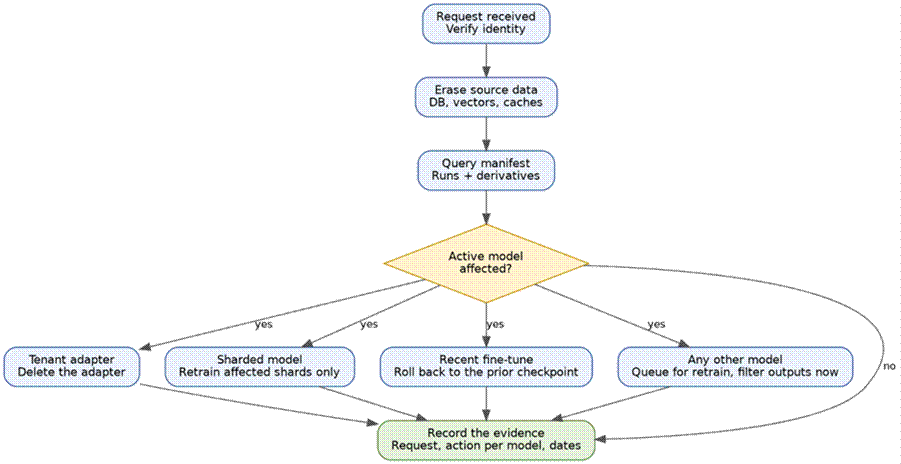
Add one more step to your AI model data deletion runbook: query the training manifest for every active model (and its derivatives) trained on this person’s data.
Then, take the cheapest action that truly removes it. Delete a tenant adapter, retrain affected shards, roll back a recent fine-tune, or queue the record for the next scheduled retrain with an output filter in the meantime.
Conclusion: you can’t delete what you never trained on
Only retraining an AI model guarantees that data will actually be deleted from it, which is why the decisions you make before training the model matter most.
Keep personal data where DELETE works, filter training data through an auditable view, scrub free text, record what went in, and never send customer data through a tier that trains on it.
You may also be interested in…
For the rest of the data deletion process, see my earlier GDPR and CCPA data deletion guide here on Simple Talk.
Simple Talk is brought to you by Redgate Software
FAQs: How to delete data from a trained AI model
1. Can you delete data from a trained AI model?
Not in the way you delete a database row. A trained model stores what it learned as weights, not records. The only guaranteed way to remove a person’s data is to retrain the model from scratch without it. Sharded training and checkpoint rollback cut the cost by retraining only the affected part. Machine unlearning and output filters lower the risk of data resurfacing but can’t prove it’s gone.
2. Does GDPR’s right to erasure apply to AI models?
It can. The European Data Protection Board’s (EDPB) Opinion 28/2024 says a model is only anonymous if the chance of extracting personal data, directly or through queries, is negligible. If you can’t show that, treat the model as personal data and within scope of the right to erasure. Unlawful training can also affect whether you may lawfully deploy the model.
3. What is algorithmic disgorgement?
Algorithmic disgorgement is a remedy used by the US Federal Trade Commission (FTC) that forces a company to delete AI models built on improperly collected data. Everalbum, Kurbo and Rite Aid were all ordered to destroy models derived from such data. If you can’t delete one record from a model, a regulator may order you to delete the whole model.
4. Do OpenAI, Anthropic and Google train on your data?
By default, OpenAI and Anthropic don’t train on API or business data, and Google doesn’t on paid Gemini API services. Consumer and free tiers differ: Google’s unpaid use may improve products and allow human review, while consumer chat products may let users choose. Deleting your data later removes stored copies such as logs and chat history, not anything a model has already learned.
5. Which data should you never train an AI model on?
Never train on direct identifiers (names, emails, phone numbers), special-category or children’s data, or records with a pending erasure request or objection. Quasi-identifiers such as ZIP code/postcode and birth date should rarely be used, and free text only after redaction. Drop, tokenize, generalize or exclude these at source, because any record shared with a model can come back out.
This document contains proprietary information and is protected by copyright law.
Copyright © 2026 Red Gate Software Limited. All rights reserved





Load comments