
Safe Database Change at Scale with Flyway Enterprise
How do teams keep database change safe, controlled, and traceable as AI-assisted coding increases the pace of delivery? Redgate Flyway Enterprise builds the necessary controls, visibility, security checks, and traceability, directly into the database change process, so every change follows a controlled and verifiable path from commit to deployment.
Why many approaches to database change fall short
Many development teams control database change as a secondary artifact of application change. The starting point for delivery is a SQL script, or an ordered set of scripts, describing how to apply the database changes needed to support the new release. Developers get very little visibility into which objects are affected and how risky the changes really are, or an easy way to verify that those changes will produce exactly the intended database state.
When the impact of database changes remains ‘opaque’ until delivery, teams are forced into a difficult trade-off. Either database changes move forward quickly using a ‘script runner’, perhaps with a few bolt-on pipeline checks, which is unsafe, or they go through manual DBA review, which can be safer but quickly becomes a bottleneck to delivery.
The first path leads to frequent deployment failure, disruption, and data integrity issues. The second leads to infrequent releases and a growing pressure to ‘work around’ the official process. Both paths increase risk, because they discover the worst problems too late, when they are harder and more costly to fix.
In either case, technical leads end up explaining to customers, or the business, why a release has been delayed, why a supposedly fixed bug has reappeared, why performance has degraded so badly, or, in the worst cases, why data has been lost or corrupted, and recovery is taking so long.
👉 As database estates grow more complex and AI accelerates change, these approaches become increasingly difficult to manage safely. For a broader look at that challenge and its business impact, see The quiet problem underneath modern software delivery: database change at scale.
This article focuses on how Flyway Enterprise addresses this problem.
The three stages of safe, scalable database delivery
At scale, safe delivery cannot rely on informal processes or knowledge that exists only in the heads of DBAs, because manually checking every change and then tracking and coordinating its delivery across environments quickly becomes the limiting factor on the pace of change.
Flyway Enterprise removes that bottleneck and gives teams a safer, more reliable basis for database delivery, so speed no longer comes at the expense of control and stability. Developers work from a known database version and state in version control, with immediate object-level visibility of what is changing and its likely impact. The changes are captured in a controlled migration path from one known database version to the next, with Flyway tracking which version is deployed to which environment. The starting point, the migration path, and the intended result are all visible and consistently validated because policy checks, tests, and reports are built into the database change process itself.
With Flyway, teams get a development and release process that is easier to coordinate safely as it scales, because risk is exposed earlier and handled earlier, rather than surfacing during deployment. Safe, scalable delivery happens across all three pipeline stages:
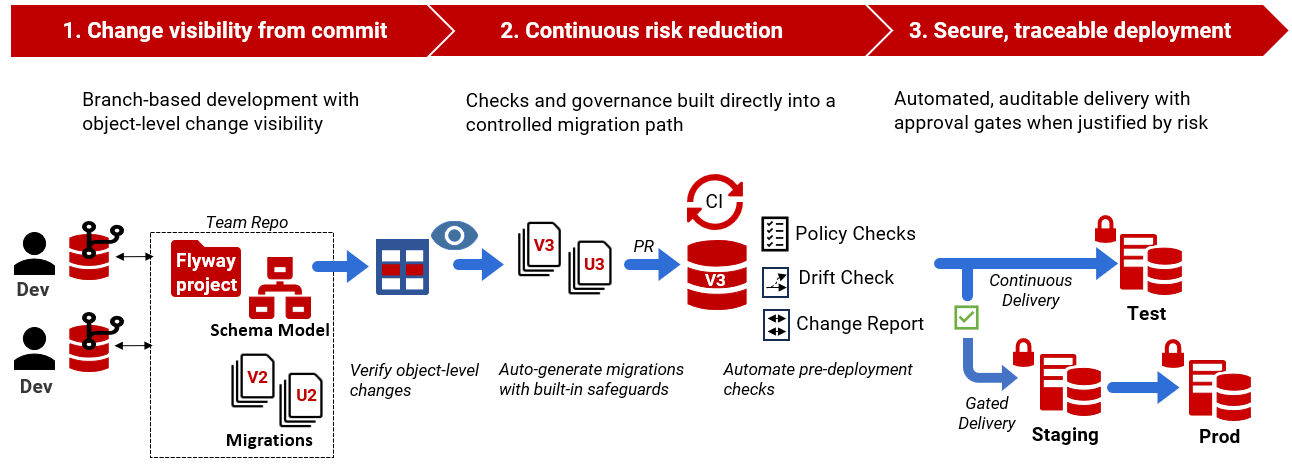
- Stage 1 – Change visibility from the moment of commit.
Scalable team-based development with immediate change visibility, earlier risk assessment, and better test and deployment planning - Stage 2 – Continuous risk reduction
Versioned migrations with built-in policy checks, drift detection, and change reports mean more reliable sign-off, shorter lead times, lower change failure rates, and faster recovery from issues. - Stage 3 – Secure, traceable deployment across environments
Verified changes delivered securely through automated or gated workflows, with a clear audit trail, enabling faster delivery, without increasing risk.
Stage 1: Change visibility from the moment of commit
Once connected to a database, Flyway Enterprise can automatically capture its object-level state into a schema model in version control. This gives teams a simple route to full change visibility and control, even for a complex legacy database, without making any bigger process changes.
Higher-risk database changes are exposed early
From the moment a change is saved to Flyway Enterprise’s schema model, its impact on the underlying tables, columns, and relationships is visible. That makes potentially high-risk changes much easier to spot early.
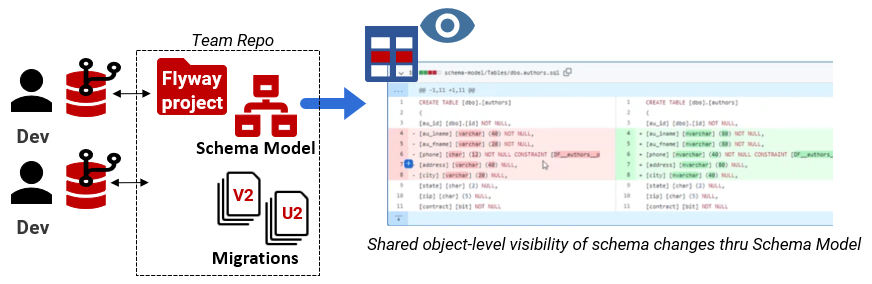
Even seemingly small changes to columns, keys, data types, constraints, or nullability can affect existing data, dependent objects, and application behavior in unpredictable ways. Flyway allows object changes to be tracked continuously through version control, and its script generation detects and accounts for the impact of changes on dependent objects.
By exposing changes and their potential impact right from the point of commit, teams get:
- better-targeted checks and tests – teams can assess which changes need closer scrutiny and plan what sort of testing is needed to mitigate risks of compatibility issues, regressions, or data migration problems
- faster root-cause analysis — especially when the root cause of a problem is not one isolated change, but a series of changes across several commits or deployments.
- clearer review and sign-off – lead engineers review a pull request in Git with full visibility of which objects are affected and how, giving them a stronger basis for deciding whether the change is safe to progress
Safer, more scalable team-based development
Database development, like any large-scale engineering process, moves faster and more efficiently when teams can work in parallel, but only if the changes are properly coordinated and merged safely.
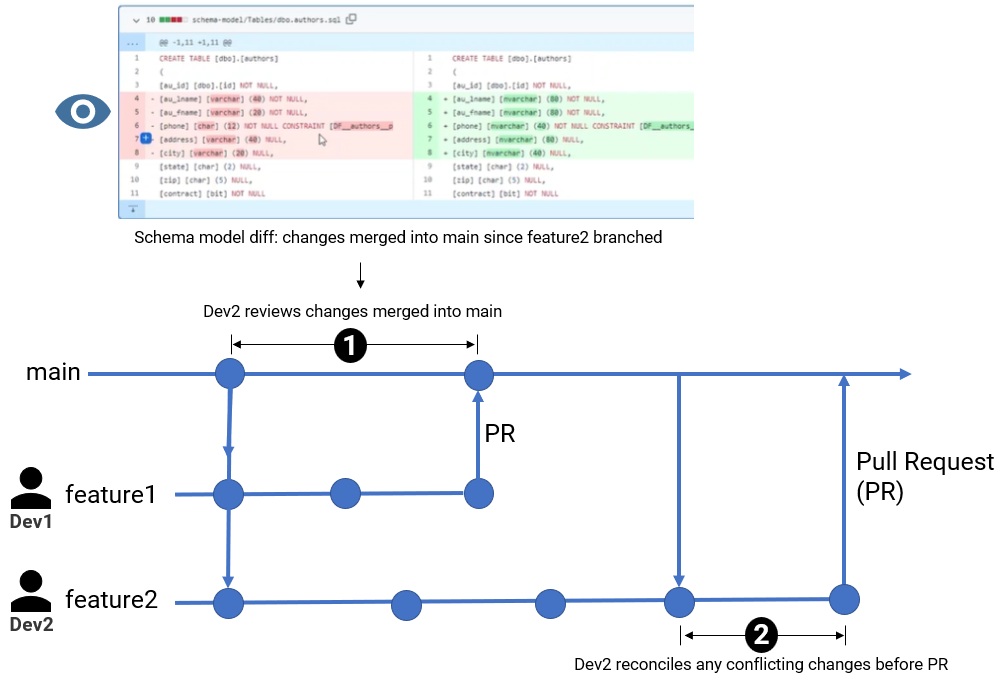
When developers have shared object-level visibility of each other’s changes, it means that team development scales more safely. Each developer can work independently, on a local database, but they can spot overlapping work early and pull in related changes before branches drift too far apart.
This makes merge process simpler and much less likely to break dependencies, overwrite earlier fixes, or reintroduce bugs. Conflicting changes are spotted and resolved before they are hardened into ordered migration scripts, when these problems are much harder to untangle.
Stage 2: Continuous risk reduction
In Flyway Enterprise, safety is built into CI, not bolted on afterwards. Every change is captured in a discrete, versioned migration between known database states, then continually integrated and verified using built-in checks and reports:
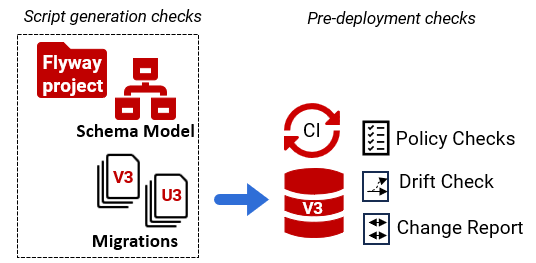
- Script generation checks – missing dependencies, data loss warnings
- Automated policy checks – catch dangerous changes early, enforce best practices
- Drift checks –reconcile out-of-process changes, keep environments aligned
- Change reports – support traceability, review, and sign-off
All these checks, tests, and sign-offs are based on a clear view of what the change does, what objects it affects, and what the database should look like as a result, rather than just a list of changes that must be applied. This provides the basis for delivery that remains safe as AI increases the pace and volume of change, because it allows for:
- Checks and controls applied in proportion to risk – standard checks and policy rules for every change, with higher-risk changes identified early enough to plan custom checks or a manual approval gate before release.
- A safer rollout strategy – earlier planning for changes that need staged deployment, such as an Expand-Contract pattern, or more careful rollback and recovery planning because of their impact on existing data
Script generation checks spot missing dependencies and destructive changes
When Flyway Enterprise generates the versioned migration and undo scripts, it correctly discovers every type of object change and fully accounts for all dependencies. For example, if a change to a table affects a dependent function, Flyway will notify you that it automatically included the function and amended it, as required.
Crucially, it will also warn about destructive changes that might cause data loss:
High: TableColumnDropDataLoss [titles] - This deployment drops the columns(s) [type] and [TypeList] from table [dbo[.[titles]…
In those cases, the team may need to plan not just the schema migration, but also the data migration. They can also use the undo scripts as the starting point for planning a safe rollback strategy.
Automated policy checks catch dangerous changes early
In Flyway Enterprise, policy checks are automated and built into the delivery path itself, so they run before every migration, across all environments, without becoming a bottleneck.
A safe change delivery process needs a reliable quality gate: a point at which risky or questionable changes are identified before they move further into testing or deployment. Flyway Enterprise’s code policy libraries automatically review pending SQL migrations for risky changes or poor practices, and can be configured either to issue a warning or to raise an error and fail the process when policies are not met:
- Redgate code policy library – focuses on dangerous or high-risk changes, including schema changes that risk data loss, datatype modifications, and security-sensitive changes such as altered roles or permission grants.
- Open-source library (SQLFluff) – catches ambiguous or fragile SQL patterns, such as queries that return an unpredictable set of columns, along with other structural issues that can degrade performance or maintainability over time.
For those responsible for delivering database changes, these automated checks are necessary to prevent the kinds of mistakes that damage trust and put your data at risk, while still allowing delivery to move quickly.
Drift checks protect against unapproved or out-of-process changes
Flyway Enterprise’s automatic drift detection helps prevent avoidable deployment failures and provides clear evidence for auditors of environment consistency and change control.
Database drift often happens when an ad hoc or emergency fix is applied directly to an environment, rather than through the official change process, and then not back-ported into version control:
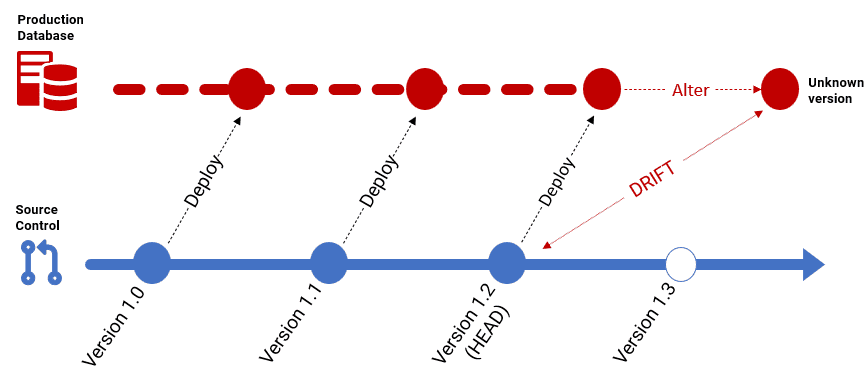
In Production, undetected drift can cause subsequent deployment failures, unexpected behavior and operational disruption. In test or QA, it can mean changes are signed off against a database that does not match what is later released. In the worst cases, drift may indicate a malicious alteration, such as an attempt to introduce a ‘backdoor access route’ to the database or escalate permissions, making it a serious security issue.
Flyway Enterprise protects against these risks by running an automatic drift detection before each deployment, comparing the target database with a snapshot of its expected state, captured after the last successful deployment and stored in the target database. If differences are found, Flyway can provide:
- A detailed drift report – showing which objects have changed, so unexpected changes can be investigated
- A corrective script – so authorized out-of-process changes can be back-ported into version control and applied to earlier environments, keeping them aligned with the approved state.
These checks reduce deployment risk and give teams clear evidence of environment consistency and change control.
Change reports provide reliable review and sign-off
Safe delivery depends not just on detecting risk, but on being able to review and approve changes with confidence. Flyway Enterprise’s change reports provide a clear, object-level view of what will change between database versions, including additions, modifications, and deletions.
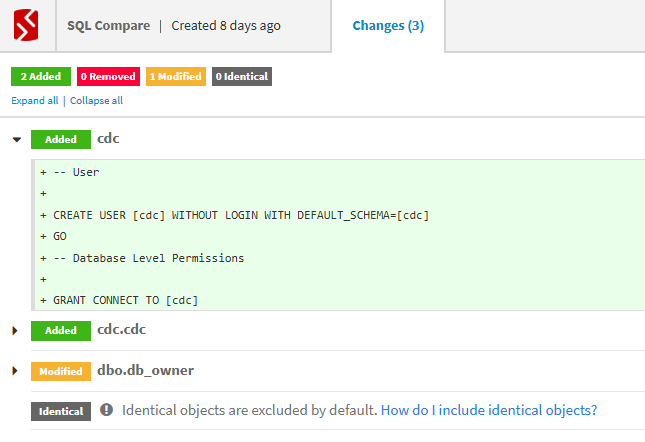
This gives reviewers a much stronger basis for sign-off than reading raw migration scripts alone. DBAs, technical leads, or approvers can see exactly which objects are affected and assess whether the scope and impact of the release match expectations before deployment proceeds.
For teams working under change-control or compliance requirements, these reports also provide a useful record of what was reviewed and approved, helping demonstrate that database changes were properly assessed before release.
Stage 3: Secure, traceable deployment across environments
Flyway Enterprise builds governance, access control, and traceability directly into the delivery pipeline, allowing teams to automate database delivery without losing control of access, approvals, or auditability.
Secure change delivery
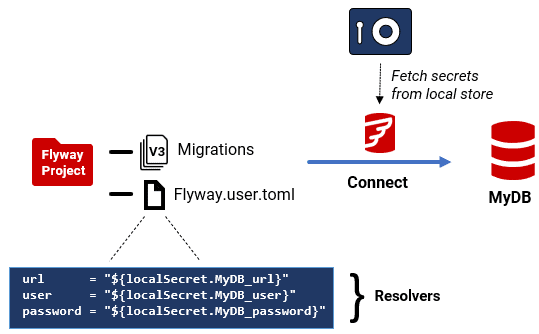
A common weakness in database change processes, whether manual or automated, is insecure or inconsistent handling of environment access: credentials stored in plain-text config files, manual hand-offs between teams, or developers needing elevated permissions outside development and test. This can cause compliance risk, because frameworks such as SOC 2 or the Digital Operational Resilience Act (DORA) expect organizations to be able to demonstrate that access is properly controlled across all data environments, not just Production.
Flyway Enterprise reduces this risk by pulling credentials, connection details, and other sensitive configuration from secure stores at runtime, so deployments remain automated while access remains controlled and consistent in each environment.
Easy integration with existing CI/CD workflows
Flyway Enterprise integrates simply with all common CI/CD platforms, and provides sample pipelines where its built-in checks will run automatically as part of an existing release process, without introducing new tools or custom scripts. Flyway Enterprise’s verified GitHub Actions, for example, make it easier to move database changes through the same CI/CD workflow as application code, while still applying database change checks and controls.
Flyway Enterprise also supports different deployment paths, according to risk. For lower-risk environments, checks and deployment can run automatically in a single job:

For higher-risk releases, teams can split checks and deployment into separate jobs, with reviewer approval in between, so change reports, drift results, policy checks, and deployment scripts can be reviewed and signed off before release.
Auditability from change request to production
Every schema change is versioned, recorded, and attributable, giving teams a clear history of what changed, when, and why. This helps in two important ways. First, it makes issue diagnosis and recovery faster, because teams can quickly trace a problem back to the relevant change. Second, it provides evidence that database changes were delivered through a controlled and consistent process across environments.
In a well-governed process, that traceability can extend from the originating support ticket or change request, through the committed change and deployment, to its operational impact, such as a change in CPU or performance of the production system, as detected in Redgate Monitor.
Summary
Safe database change at scale requires automation, yes, but automation alone is not enough. The change management process must establish a reliable, consistent, and verifiable migration path from one known database state to the next, with continuous visibility of what is changing and continuous assessment of the risks those changes introduce.
Flyway Enterprise provides that path. It makes change visible from the point of commit, captures each change in a versioned migration between known database states, and applies built-in policy checks, drift detection, change reporting, and controlled deployment throughout the delivery process.
During development, teams can coordinate changes more safely and spot higher-risk changes as soon as they are committed, while there is still time to plan how to handle them safely. During delivery, changes that risk data integrity or security, as well as unexpected or out-of-process changes, can be detected before they cause deployment failure, compliance issues, or misleading test results. Throughout the pipeline, review and sign-off are based on clear, traceable evidence of exactly what changed and why.
The result is a delivery process with fewer avoidable incidents, lower change failure rates, faster diagnosis and recovery when something goes wrong, and clearer evidence of governance and control across every environment. This is what safe database change at scale looks like: risk is assessed continuously, changes are always verified before release, and delivery scales smoothly without sacrificing safety.
Tools in this post
You may also like
-

Article
Adding Test Data to Databases During Flyway Migrations
How to generate "realistic but fake" SQL Server test data, using SQL Data Generator, and then use SQL Data Compare to produce an INSERT script that Flyway can run to load the data into the database. The technique is useful for managing small volumes of test data or for "topping up" existing data when you create new entities.
-

Article
A Real-world Implementation of Database DevOps: People, Processes, Tools
This series of articles describes a path you can take to transforming an existing, manual and error-prone database development and release process into an automated and reliable Database DevOps 'pipeline', starting here with an overview of what we set out to achieve, and the people, processes and tools involved.
-
Webinar
Simplifying and Streamlining Database Deployment: A Flyway Approach
Join us for "Simplifying and Streamlining Database Deployment: A Flyway Approach," where we'll explore how Flyway Enterprise can help you streamline your database deployments while achieving faster, higher-quality results.
-
Article
New Redgate Flyway Release - Automate Even More
Read on to learn about how you can automate even more things with Flyway like project setup and state-based deployments. We’ll share how you can get the latest version and things you need to know when upgrading.
-
Article
Creating Flyway Migration Files using Redgate Schema Comparison Tools
How to use Redgate's schema comparison engines to generate object-level scripts for every database version that Flyway creates, and then use them to create ad-hoc, Flyway-compatible migration files.
-

Webinar
Level Up with Flyway - Online Training Hub
Throughout this course, you will explore a broad spectrum of modules focusing on the full Flyway solution, from Development through to Deployment and Test Data Management. Designed as a three-session course, make sure to register at each of the links below to ensure you’re in the know for all three. Module 1: Database Development with


